Effects of Binder on Physical and Mechanical Properties on Unglazed Ceramic Tiles
M. Mintu Ali, M Nion, Md. Shamimur Rahman
Abstract
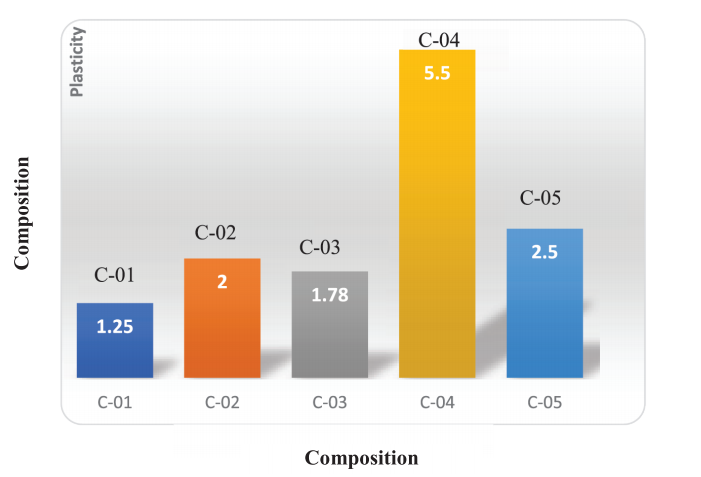
This research mainly focuses on the behavior and functions of different binders and their significant effects on traditional ceramic tiles made by the hydraulic press at 110 bar pressure. Nowadays, the demand for ceramic tiles is increasing, and so their properties should be modified to meet these demands. In that mind, these traditional ceramic tiles were prepared by using various binders. Several tests were carried out for characterization. Moisture contents, firing shrinkage, water absorption, firing weight loss were carried out to check physical properties, and also plasticity test was done for tiles forming capability of raw materials. Besides, modulus of rupture test and impact tests were carried out to check the mechanical properties. Molasses, eggshell, carboxymethyl Cellulose, rice boiling water, flowers were used as a binder in ceramics tiles manufacturing. Each test showed better physical and mechanical properties using carboxymethyl Cellulose.
Conclusion
Carboxymethyl cellulose is an excellent binder, indeed. All of these properties of ceramic tiles using CMC were good because of their excellent binding behavior. From this research, it can be suggested that using two or more binders together in ceramic tiles formation. The properties also may be more useful for different applications all over the world.
References
[1]
A. Olgun*, Y. Erdogan, Y. Ayhan, B. Zeybek, "Development of ceramic tiles from coal fly ash and tincal ore waste," Ceramics International 31 (2005) 153–158
[2]
S. A. Jahan, S. Parveen*, S. Ahmed and M. Moniruz Zaman, <em>"Studies on the Physico-Chemical Properties of Ceramic Tiles Produced from Locally Available Raw Materials</em>," Bangladesh J. Sci. Ind. Res. 43(1), 77-88, 2008
[3]
B. Su a, ∗, T.W. Button b, <em>"A comparative study of viscous polymer processed ceramics based on aqueous and non-aqueous binder systems</em>," Journal of materials processing technology 2 0 9 (2009) 153–157
[4]
Pornchai Rachtanapun 1, a, Sukum Eitssayeam 2, b and Kamonpan Pengpat 2, c, "Study of Carboxymethyl Cellulose from Papaya Peels as Binder in Ceramics," Advanced Materials Research Vols 93-94 (2010) pp 17-21
[5]
Yunes Beygi Khosrowshahi and Amin Salem *, "Influence of Polyvinyl Alcohol and Carboxymethyl Cellulose on the Reliability of Extruded Ceramic Body: Application of Mixture Design Method in Fabricating Reliable Ceramic Raschig Rings," Int. J. Appl. Ceram. Technol., 8 [6] 1334–1343 (2011)
[6]
Benneth C. Chukwudi1 and Boniface A. Okorie2, "Evaluation of the Physical and Mechanical Properties of Ceramic Tiles Processed Using Steel Slag," Advanced Materials Research Vol. 856 (2014) pp 257-261
[7]
Kalayanee Kooptarnond, Danupon Tonnayopas, "Using weathered granite for ceramic tile production," TMS (The Minerals, <em>Metals& Materials Society)</em>, 2007
[8]
David Onoja PATRICK*, Haruna Mavakumba KEFAS, Yakubu Mandafiya JOHN, and Victor Idankpo AMEH, "Investigation of the physical properties of tiles produced with Otukpo clay, <em>" Leonardo Electronic Journal of Practices and Technologies</em>, ISSN 1583-1078, Issue27, July-December 2015, p. 162-176
[9]
Pat Sooksaen1,2, a, Pathompong Puathawee3,b, "Properties of Unglazed Ceramics Containing Aluminum Dross as a Major Component," Trans Tech Publications, ISSN: 1662-9779, Vol. 266, pp 182-186, 2017
[10]
Anita Terjék a,*, Annamária Dudás b, "Ceramic Floor Slipperiness Classification – A new approach for assessing slip resistance of ceramic tiles," Construction and Building Materials 164 (2018) 809–819
[11]
Cristiano Fragassa 1, “Limits in application of international standards to innovative ceramic solutions”, <em>International Journal for Quality Research 9(2) 279–298</em>, ISSN 1800-6450, 22.05.2015