Reduction of Surface Resistance of Jute Fiber by Coating with PEDOT and Characterization of the Effect of Different Parameters on Resistance
Alberuni Aziz, Mostafa Khan, Mohammad Abdul Jalil
Abstract
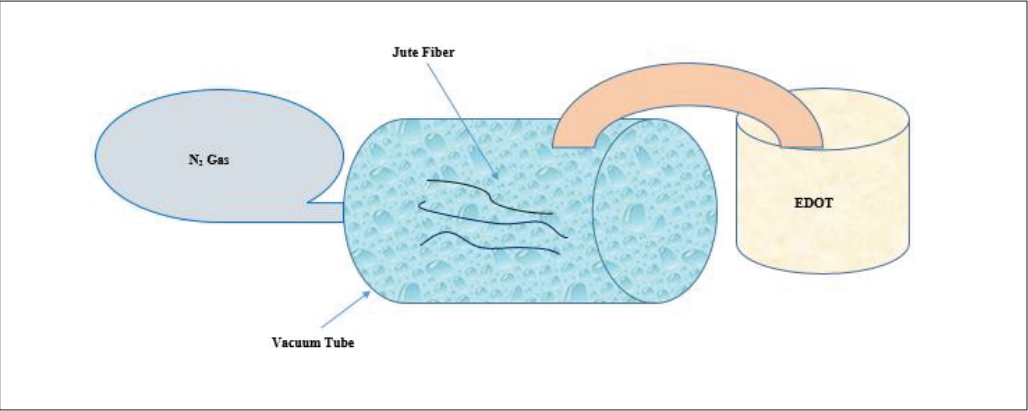
Poly (3, 4-ethylenedioxythiophene) (PEDOT) is a highly conductive polymer which is most widely used for surface coating purposes. In this study for reducing surface resistance oxidative chemical vapor deposition (OCVD) technique was used for coating PEDOT on jute fiber, which is composed of cellulosic natural fiber and ferric (III) chloride (FeCl3) was used as an oxidant for surface modification before polymerization. The objective of this study was to reduce resistance of jute fiber and improve conductive behavior. The surface resistance of jute fiber was investigated by changing different polymerization parameters such as oxidant concentration, soaking time, drying time, reaction time and reaction temperature. Optimum resistance values were recorded for 15% oxidant concentration, 150 min soaking time, 30 min drying time, 75° C temperature and 30 min reaction time. The novelty of this work is to introduce jute fiber for conductive material formation through PEDOT deposition technique.
Conclusion
The surface resistance of jute fiber has been reduced by polymerization reaction of EDOT using OCVD technique and the effect of different polymerization parameters has been studied here. Results shows that different parameters have a strong influence on jute fiber resistance. By controlling this parameters very lower resistance fibers are possible to produce which will be applicable for smart textile applications, heat generation, semi-conductor applications and other technical applications. As jute is a natural fiber material which is eco-friendly and easily biodegradable, its application in smart textile will play a positive impact on our earth and it will be better for a green and sustainable world.
ACKNOWLEDGEMENT
The authors are thankful to Department of Textile Engineering and Department of Chemistry, Khulna University of Engineering & Technology (KUET), for giving the opportunity of using lab.
References
[1]
Xiaoming Yang, Songmin Shang, Liang Li, Xiao-Ming Tao, Feng Yan, “Vapor phase polymerization of 3,4-ethylenedioxythiophene on flexible substrate and its application on heat generation”, Polymers for Advance Technologies, Volume 22, Issue 6, 2011.
[3]
Md. Syduzzaman, Sarif Ullah Patwary, Kaniz Farhana, Sharif Ahmed, <em>“Smart Textiles and Nano-Technology: A General Overview”</em>, <em>J Textile Sci Eng</em>, Volume 5, Issue 1, 4172/2165-8064, 2015.
[4]
Subrata Chandra Das*, Debasree Paul, Sk. Md. Mahamudul Hasan, Nasif Chowdhury, Md. Eanamul Haque Nizam, <em>“Smart Textiles- New Possibilities in Textile Engineering”</em>, International Conference on Mechanical, <em>Industrial and Materials Engineering(ICMIME2013) 1-3 RUET</em>, Rajshahi, Bangladesh, 2013.
[5]
Tariq Bashir, Mikael Skrifvars* and Nils-Krister Persson, “Production of highly conductive textile viscose fibers by chemical vapor deposition technique: a route to continuous process”, Polym. Adv. Technol., Volume 22, 2214–2221, 2010.
[6]
Mikael Skrifvarsa*, Tariq Bashir, Majid Ali, Sung-Woo Cho and Nils-Krister Persson, “OCVD polymerization of PEDOT: effect of pre-treatment steps on PEDOT-coated conductive fibers and a morphological study of PEDOT distribution on textile yarns”, Polym. Adv. Technol., DOI: , 2012
https://doi.org/10.1002/pat.3073
[7]
Dalmau Reig-i-Plessis∗, Eugen Panaitescu, Akshai Baskaran, and Latika Menon, “A Simple Chemical Vapor Deposition Method for the Production of Highly Conductive Polymer Poly(3,4-ethylenedioxythiophene)”, <em>Journal of Nanoscience and Nanotechnology</em>, Volume 13, 4045–4051, 2013.
[8]
Anilyn C. Macasaquit and Christina A. Binag, “Preparation of Conducting Polyester Textile by in situ Polymerization of Pyrrole, <em>Philippine Journal of Science”</em>, Volume 139, Issue 2, 189-196, 2010.
[9]
Surajit Sengupta, “Electrical resistance of jute fabrics”, <em>Indian Journal of Fibre & Textile Research</em>, Volume 37, 55-59, 2012.
[10]
Saiful Izwan Abd Razak, Nor Syuhada Azmi, Khalida Fakhruddin, “Coating of Conducting Polymers on Natural Cellulosic Fibers”, <em>Web of Science</em>, , 2016
https://doi.org/10.5772/63304
[11]
L. Dall’Acqua, C. Tonin∗, A. Varesano, M. Canetti, W. Porzio, M. Catellani, “Vapour phase polymerisation of pyrrole on cellulose-based textile substrates”, Synthetic Metals, Volume 156, 379-386, 2006.
[12]
Zheng, Huajing Jiang, Yadong Xu, Jianhua Yang, Yajie, “Study on Conductivity Properties of PEDOT Prepared through a Modified LB Film Method”, Chin. J. Chem., Volume 29, 415-421, 2011.
[13]
John P. Lock, Sung Gap Im, Karen K. Gleason, “Oxidative Chemical Vapor Deposition of Electrically conducting Poly (3, 4-ethylenedioxythiophene) Films”, Macromolecules, Volume 39, Issue 16, 5326-5329, 2006.
[14]
Shaharia Pavel, Vijit Supinit, “Bangladesh Invented Bioplastic Jute Poly Bag and International Market Potentials”, <em>Open Journal of Business and Management</em>, Volume 5, 624-640, 2017.
[15]
Davide Beneventi, Sabrine Alia, Sami Boufi, Didier Chaussy, Patrice Nortier, “Pollymerization of pyrrole on cellulose fibers using a FeCl3 impregnation-pyrrole polymerization sequence”, Cellulose, Volume 13, Issue 6, 725-734, 2006.
[16]
M. A. Ali, H. H. Kim, C. Y. Lee, H. S. Soh, and J. G. Lee, “Effects of the FeCl3 Concentration on the Polymerization of Conductive Poly(3,4-ethylenedioxythiophene) Thin Films on (3-aminopropyl) Trimethoxysilane Monolayer-Coated SiO2 Surfaces”, Met. Mater. Int., Volume 15, Issue 6, 977-981, 2009.
[17]
Sung Gap Im, David Kusters, Wonjae Choi, Salmaan H. Baxamusa, M. C. M. van de Sanden, and Karen K. Gleason, “Conformal Coverage of Poly(3,4-ethylenedioxythiophene) Films with Tunable Nanoporosity via Oxidative Chemical Vapor Deposition”, ACS Nano, Volume 2, Issue 9, 1959-1967, 2008.
[18]
R. Dams, D. Vangeneugden, D. Vanderzande, “Plasma deposition of thiophene derivatives under atmospheric pressure”, Chemical Vapor Deposition, Volume 12, Issue 12, 719-722, 2006.
[19]
Robert Brooke, Manrico Fabretto, Nastasja Vucaj, Kamil Zuber, Eliza Switalska, Lachlan Reeks, Peter Murphy and DrewEvans, “Effect of oxidant on the performance of conductive polymer films prepared by vacuum vapor phase polymerization for smart window applications”, Smart Mater. Struct. Volume 24 , 035016 (9pp), 2015.
[20]
Yujie Ding, Michael A. Invernale, and Gregory A. Sotzing*, “Conductivity Trends of PEDOT-PSS Impregnated Fabric and the Effect of Conductivity on Electrochromic Textile”, <em>Applied materials and interfaces</em>, Volume 2, Issue 6, 1588–1593, 2010.
[21]
Xue P., Tao X. M., “Morphological and Electromechanical Studies of Fibers Coated with Electrically Conductive Polymer”, <em>Journal of Applied Polymer Science</em>, Volume 98, 1844–1854, 2005.
[22]
Dominik Vahle, Robin Böttjer, Kerstin Heyden and Andrea Ehrmann, “Conductive polyacrylonitrile/graphite textile coatings”, <em>AIMS Materials Science</em>, Volume 5, Issue 3, 551–558, June 2018.
[23]
Kony Chatterjee, Jordan Tabor and Tushar K. Ghosh, “Electrically Conductive Coatings for Fiber-Based E-Textiles”, Fibers, Volume 7, Issue 51, June 2019.
[24]
Granch Berhe Tseghai, Desalegn Alemu Mengistie, Benny Malengier, Kinde Anlay Fante and Lieva Van Langenhove, “PEDOT:PSS-Based Conductive Textiles and Their Applications”, Sensors, March 2020.
[25]
T. Bashir, M. Skrifvars, N.-K. Persson,” Surface modification of conductive PEDOT coated textile yarns with silicon resin”, <em>Materials Technology: Advanced Performance Materials</em>, Volume 26, Issue 3, 135-139, 2011.
[26]
Tariq Bashir, “Conjugated Polymer-based Conductive Fibers for Smart Textile Applications”, <em>Polymer Technology</em>, 2013.