Dynamic Behaviour of Ballasted Railway Track Foundation under Various Conditions of the Train-Track-Ground System
Md. Abu Sayeed
Abstract
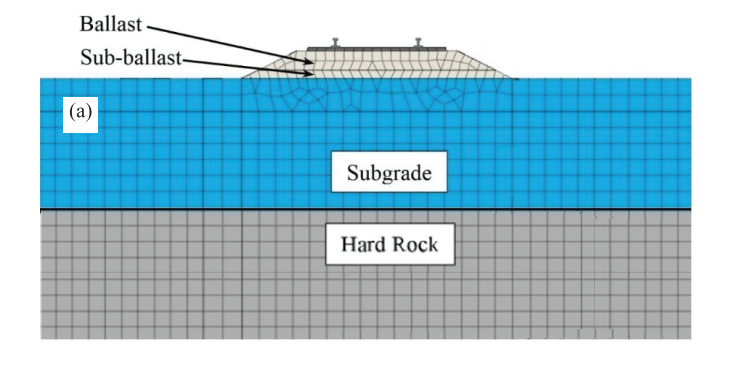
Nowadays, the competition among different public transportation in terms of speed, safety, comfortability, carrying capacity, and cost has significantly increased the demand for faster and heavier trains. This demand indicates probable pressure to build railway tracks appropriate for high-speed trains (HSTs) and heavy wheel loads (HWLs) and they are generally responsible for strong vibrations in the train-track-ground system. They raise the danger of track damages and train derailment. Hence, an investigation into the impact of various parameters that affect the track performance is essential. This study is vital for railway geotechnical engineers to reach an optimum plan for both the railway track design and lifetime maintenance. In this paper, sophisticated three-dimensional finite element modelling has been developed to investigate the impact of various parameters including, train speed, track subgrade thickness, loading amplitude and train geometry on the dynamic responses of the train-track-ground system. The outcomes are critically analyzed and discussed.
Conclusion
In this paper, sophisticated 3D finite elements modelling was performed to simulate the dynamic behavior of ballasted railway track foundation under various conditions of the train-track-ground system including the train speed, subgrade thickness, loading amplitude and wheel spacing. From the obtained results, the following conclusions are drawn:
The amplitude of dynamic track response increases with the increase in the train speed; however, the track response increases rapidly when the train speed exceeds around 65% of the critical speed. Consequently, 65% of the critical speed value can be considered as the acceptable speed limit for safe movement of train.
The subgrade thickness has a significant influence on the track sleeper displacement and critical speed of the train-track-ground system. The value of the critical speed decreases with the increase in the subgrade thickness.
The amplitude of dynamic track response increases uniformly with the amplitude of train loading. On the other hand, the dynamic track response decreases with the increase of wheel spacing.
5. Acknowledgement
The author would like to thank the Department of Civil Engineering and Curtin University for their supports to do this study.
References
[1]
V. V. Krylov, A. R. Dawson, M. E. Heelis, and A. C. Collop, "Rail movement and ground waves caused by high-speed trains approaching track-soil critical velocities, <em>" Proceedings of the Institution of Mechanical Engineers</em>, Part F: Journal of Rail and Rapid Transit, vol. 214, pp. 107-116, 2000.
[2]
P. Alves Costa, A. Colaço, R. Calçada, and A. S. Cardoso, "Critical speed of railway tracks. Detailed and simplified approaches," Transportation Geotechnics, vol. 2, pp. 30-46, 2015.
[3]
C. Madshus and A. M. Kaynia, "High-speed railway lines on soft ground: Dynamic behaviour at critical train speed, <em>" Journal of Sound and Vibration</em>, vol. 231, pp. 689-701, 2000.
[4]
A. M. Kaynia, C. Madshus, and P. Zackrisson, "Ground vibration from high-speed trains: Prediction and countermeasure, <em>" Journal of Geotechnical and Geoenvironmental Engineering</em>, vol. 126, pp. 531-537, 2000.
[5]
H. A. Dieterman and A. V. Metrikine, "Steady-state displacements of a beam on an elastic half-space due to a uniformly moving constant load, <em>" European Journal of Mechanics</em>, A/Solids, vol. 16, pp. 295-306, 1997.
[6]
X. Sheng, C. J. C. Jones, and D. J. Thompson, "A theoretical study on the influence of the track on train-induced ground vibration, <em>" Journal of Sound and Vibration</em>, vol. 272, pp. 909-936, 2004.
[7]
A. El Kacimi, P. K. Woodward, O. Laghrouche, and G. Medero, "Time domain 3D finite element modelling of train-induced vibration at high speed, <em>" Computers and Structures</em>, vol. 118, pp. 66-73, 2013.
[8]
L. S. Sowmiyaa, J. T. Shahu, and K. K. Guptac, "Effect of geosynthetic reinforcement on clayey subgrade – three dimensional finite element analysis on railway track," in Procedings of the International Conference on Ground Improvement and Ground control, 2012.
[9]
L. Andersen and S. R. Nielsen, "Boundary element analysis of the steady-state response of an elastic half-space to a moving force on its surface, <em>" Engineering Analysis with Boundary Elements</em>, vol. 27, pp. 23-38, 2003.
[10]
X. Bian, C. Cheng, J. Jiang, R. Chen, and Y. Chen, "Numerical analysis of soil vibrations due to trains moving at critical speed," Acta Geotechnica, vol. 11(2), pp. 1-14, 2014.
[11]
M. A. Sayeed and M. A. Shahin, "Investigation into Impact of Train Speed for Behavior of Ballasted Railway Track Foundations," ICTG, <em>Procedia Engineering</em>, vol. 143, pp. 1152-1159, 2016.
[12]
M. A. Sayeed, "Design of ballasted railway track foundations using numerical modelling with special reference to high speed trains," PhD Thesis, Curtin University, 2016.
[13]
M. A. Sayeed and M. A. Shahin, "Three-dimensional numerical modelling of ballasted railway track foundations for high-speed trains with special reference to critical speed," Transportation Geotechnics, vol. 6, pp. 55-65, 2016.
[14]
MIDAS IT. Co. Ltd., <em>Manual of GTS-NX 2013 v1.2: New experience of geotechnical analysis system</em>, MIDAS Company Limited, South Korea 2013.
[15]
E. T. Selig and D. Li, "Track modulus: Its meaning and factor influencing it, <em>" Transportation Research Record</em>, vol. 1470, pp. 47 - 54, 1994.
[16]
J. T. Shahu, N. S. V. Kameswara Rao, and Yudhbir, "Parametric study of resilient response of tracks with a sub-ballast layer, <em>" Canadian Geotechnical Journal</em>, vol. 36, pp. 1137-1150, 1999.
[17]
V. Galavi and R. B. J. Brinkgreve, <em>"Finite element modelling of geotechnical structures subjected to moving loads</em>," in VIII ECNUMGE - Numerical Methods in Geotechnical Engineering. vol. 1, Hicks et al., Netherlands, Taylor and Francis - Balkema, pp. 235-240, 2014.
[18]
G. Kouroussis, O. Verlinden, and C. Conti, "Finite-dynamic model for infinite media: Corrected solution of viscous boundary efficiency, <em>" Journal of Engineering Mechanics</em>, vol. 137, pp. 509-511, 2011.
[19]
J. Lysmer and R. L. Kuhlemeyer, "Finite dynamic model for infinite media, <em>" Journal of the Engineering Mechanics Division</em>, ASCE, vol. 95, pp. 859-877, 1969.
[20]
I. Chowdhury and S. P. Dasgupta, <em>"Computation of Rayleigh damping coefficients for large systems</em>," The Electronic Journal of Geotechnical Engineering, vol. 8, pp. 1-11, 2003.
[21]
N. M. F. Araújo, "High-speed trains on ballasted railway track: Dynamic stress field analysis," PhD Thesis, Universidade do Minho, Portugal, 2011.
[22]
G. Kouroussis, O. Verlinden, and C. Conti, "Ground propagation of vibrations from railway vehicles using a finite/infinite-element model of the soil, <em>" Journal of Rail and Rapid Transit</em>, vol. 223, pp. 405-413, 2009.
[23]
H. Takemiya, "Simulation of track-ground vibrations due to a high-speed train: the case of X-2000 at Ledsgard, <em>" Journal of Sound and Vibration</em>, vol. 261, pp. 503-526, 2003.
[24]
V. V. Krylov, Noise and Vibration from High-speed Trains, London, Thomas Telford, 2001.
[25]
T. Jeffs and G. P. Tew, <em>A review of track design procedures</em>, Vol. 2, Sleepers and Ballast, <em>BHP Research - Melbourne Laboratories</em>, Railways of Australia, Victoria, Australia, 1991.
[26]
G. Kouroussis, O. Verlinden, and C. Conti, "Free field vibrations caused by high-speed lines: measurement and time domain simulation, <em>" Soil Dynamics and Earthquake Engineering</em>, vol. 31, pp. 692-707, 2011.
[27]
L. Hall, "Simulations and analyses of train-induced ground vibrations in finite element models, <em>" Soil Dynamics and Earthquake Engineering</em>, vol. 23, pp. 403-413, 2003.