Behaviors of Geo-synthetic Reinforcements for Mat Foundation in Very Soft Clay
Abstract
Geo-synthetic reinforcing is the most economical ground improvement technique in very soft soils. This process is applicable to various types of foundations. Normally, earth reinforcing is used for a square and continuous foundation based on past studies. Several analytical and empirical formulae have already been developed for square and continuous foundations. In the present research, geo-synthetic reinforcing is used for mat foundation. Variable parameters are width to length ratio of mat, coefficient, reinforcing layers, and replaced zone to foundation depth ratio. Five layers of geo-synthetic reinforcement, eight coefficient values, and several depth ratios are considered for analysis. Mild steel is used for geo-synthetic reinforcements. The minimum individual geo-synthetic reinforcing layer depth is 25mm. Prediction of critical width to depth ratio of mat and numbers of reinforcing layers are the main goal of this research. The factor of safety shows zero values for the fourth and fifth layers of reinforcing. Higher thickness of replaced zone expresses zero factors of safety for some cases of fourth and fifth reinforcing layers. The lower thickness of reinforcing layers expresses a stable condition of very soft clay. Also, higher reinforcing layer expresses the worst condition of very soft clay. Variations of foundation coefficients influenced the bearing capacity of very soft soil. Three layers geo-synthetic reinforcing show stable condition of very soft clay for various widths to length ratios and foundation coefficients.
Conclusion
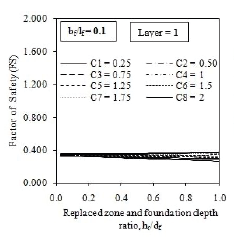
Number of reinforcing layers is influenced bearing capacity of very soft clay but higher number of reinforcing layers with higher thicknesses of layers indicates worst condition of soil. Zero factor of safety shows failure mode of very soft clay. Three reinforcing layers are suitable for mat foundation for any thickness of reinforcing zone at 0.1 widths to length ratio of mat. When width to length ratio of mat varies from 0.2 to 0.8 then suitable thickness of reinforcing layers are 25mm, 50mm and 75mm for single, double and triple layer earth reinforcing for getting higher factor of safety. Fourth and fifth layer earth reinforcing have been expressed zero factor of safety for all values of width to length ratio of mat except 0.1 widths to length ratio. Maximum factor of safety has been observed at 0.8 widths to length ratio of mat for three layers reinforcing and maximum foundation coefficient. Higher thickness of reinforcing zone is not suitable when width to length ratio of mat varies from 0.2 to 0.8. Based on the present study, suitable width to length ratio of mat is 0.1 because factor of safety is increasing gradually with the increment of thickness of reinforcing zone. However, no abnormalities have been found of analysis results and uniform variation of factor of safety has been observed with the variations of various parameters.