Enhancing Higher Education Quality in Bangladesh: Insights from Stakeholders
Shoaib Islam, Monjurul Hassaan, Jannat Ara Shewly, Joy Barua, Md. Shawan Uddin
Abstract
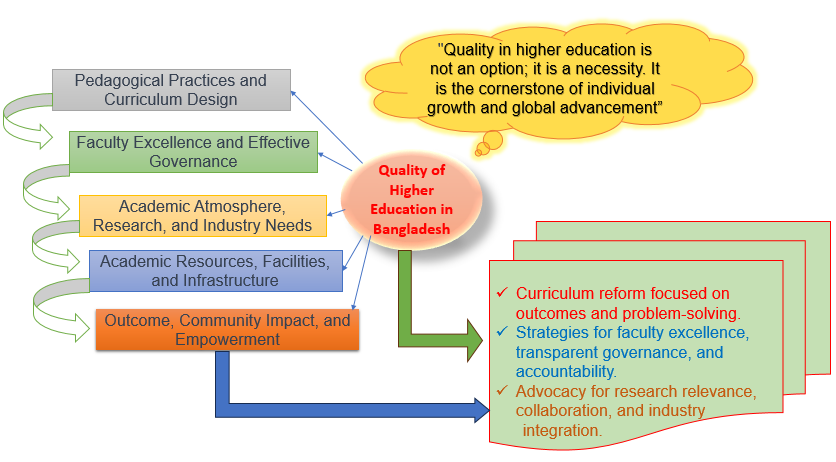
The prime objective of this research paper is to dive into the stakeholders' perspectives to gain insights and comprehend their understanding of ensuring the quality of education in the higher educational institutions in Bangladesh. This study employs an interpretive paradigm, inductive reasoning, and qualitative approach adopting in-depth interviews with 30 teachers, students, and staff of 8 public universities in Bangladesh using a purposive sampling technique. This study finds that pedagogical practices, curriculum design, academic atmosphere, academic resources, facilities, infrastructure, considerable outcomes, community impact, and empowerment all require urgently needed comprehensive improvements to the quality of higher education in Bangladesh. This study significantly contributes to ensuring the quality of higher education in Bangladesh. This paper provides policymakers, educational institutions, and stakeholders with a roadmap for bringing about a positive change in the quality of the educational system in Bangladesh.
Conclusion
This research project will provide some insight into the stakeholders' viewpoint, and policymakers will learn what the stakeholders need and think about ensuring higher education. In addition, this research will significantly contribute to the existing literature since studies related to higher education’s quality assurance are relatively scanty, especially in the context of the universities in Bangladesh. This research will also introduce new methods leveraging technology and intractable exchanges among the stakeholders, encouraging internationalization, fostering collaboration with industry, and building a culture of continuous learning. This paper will provide insights for policymakers, educators, and the government about assuring the quality of higher education. The results of this study can also help shape conversations on the future course of educational policies and practices as well as the larger conversation on quality assurance in higher education. Educational institutions can better meet the expectations of students, employers, and society at large by understanding stakeholders' demands and integrating them with quality assurance procedures.
References
[2]
Md. N. Haque, M. Abtahee, A. A. Islam, and Md. A. Sadiq, “Students’ perception of environmental sustainability (ES) exercises at higher education institutions (HEIs) in Bangladesh, <em>” Frontiers in Engineering and Built Environment</em>, vol. 3, no. 3, pp. 167–179, Aug. 2023, doi
https://doi.org/10.1108/febe-07-2022-0030
[3]
J. KOHLER, “Quality Assurance, Accreditation, and Recognition of Qualifications as Regulatory Mechanisms in the European Higher Education Area,” Higher Education in Europe, vol. 28, no. 3, pp. 317–330, Oct. 2003, doi
https://doi.org/10.1080/0379772032000119973
[4]
W.-J. Shim and K. Walczak, “The Impact of Faculty Teaching Practices on the Development of Students’ Critical Thinking Skills, <em>” International Journal of Teaching and Learning in Higher Education</em>, vol. 24, no. 1, pp. 16–30, 2012, [Online]. Available: http://www.isetl.org/ijtlhe/
[5]
M. J. Alam, K. Ogawa, and S. R. Bin Islam, “e-Learning as a Doubled-Edge Sword for Academic Achievements of University Students in Developing Countries: Insights from Bangladesh,” Sustainability (Switzerland), vol. 15, no. 9, May 2023, doi
https://doi.org/10.3390/su15097282
[7]
V. Villarroel, M. Benavente, M. J. Chuecas, and D. Bruna, “Experiential learning in higher education. A student-centered teaching method that improves perceived learning., <em>” Journal of University Teaching and Learning Practice</em>, vol. 17, no. 5, pp. 1–16, 2020, doi
https://doi.org/10.53761/1.17.5.8
[8]
A. Cockett and C. Jackson, <em>“The use of assessment rubrics to enhance feedback in higher education: An integrative literature review</em>,” Nurse Education Today, vol. 69. Churchill Livingstone, pp. 8–13, Oct. 01, 2018. doi
https://doi.org/10.1016/j.nedt.2018.06.022
[9]
M. Baeten, K. Struyven, and F. Dochy, “Student-centred teaching methods: Can they optimise students’ approaches to learning in professional higher education?,” Studies in Educational Evaluation, vol. 39, no. 1, pp. 14–22, Mar. 2013, doi
https://doi.org/10.1016/j.stueduc.2012.11.001
[10]
M. Hynie, K. Jensen, M. Johnny, J. Wedlock, and D. Phipps, <em>“Student internships bridge research to real world problems</em>,” Education and Training, vol. 53, no. 1, pp. 45–56, Feb. 2011, doi
https://doi.org/10.1108/00400911111102351
[11]
N. Rahnuma, “The Bangladeshi higher education quality assurance framework: a pathway for transformation,” Quality in Higher Education, vol. 26, no. 1, pp. 14–31, Jan. 2020, doi
https://doi.org/10.1080/13538322.2020.1729309
[12]
W.-J. Shim and K. Walczak, “The Impact of Faculty Teaching Practices on the Development of Students’ Critical Thinking Skills, <em>” International Journal of Teaching and Learning in Higher Education</em>, vol. 24, no. 1, pp. 16–30, 2012, [Online]. Available: http://www.isetl.org/ijtlhe/
[13]
L. Riebe, R. Sibson, D. Roepen, and K. Meakins, “Impact of Industry Guest Speakers on Business Students’ Perceptions of Employability Skills Development,” Industry and Higher Education, vol. 27, no. 1, pp. 55–66, Feb. 2013, doi
https://doi.org/10.5367/ihe.2013.0140
[14]
M. Husain and S. Khan, <em>“Students’ feedback: An effective tool in teachers’ evaluation system</em>,” Int J Appl Basic Med Res, vol. 6, no. 3, p. 178, 2016, doi
https://doi.org/10.4103/2229-516x.186969
[15]
J. Bercovitz and M. Feldmann, “Entpreprenerial Universities and Technology Transfer: A Conceptual Framework for Understanding Knowledge-Based Economic Development.”
[16]
J. KOHLER, “Quality Assurance, Accreditation, and Recognition of Qualifications as Regulatory Mechanisms in the European Higher Education Area,” Higher Education in Europe, vol. 28, no. 3, pp. 317–330, Oct. 2003, doi
https://doi.org/10.1080/0379772032000119973
[17]
J. Bercovitz and M. Feldmann, “Entpreprenerial Universities and Technology Transfer: A Conceptual Framework for Understanding Knowledge-Based Economic Development.”
[18]
N. Becket and M. Brookes, “Quality management practice in higher education - What quality are we actually enhancing?, <em>” Journal of Hospitality</em>, Leisure, Sport and Tourism Education, vol. 7, no. 1. pp. 40–54, Apr. 2008. doi
https://doi.org/10.3794/johlste.71.174
[19]
J. F. Wergin, <em>“Resource Review: Higher Education: Waking up to the Importance of Accreditation</em>,” 2005.
[20]
M. D. B. Castro and G. M. Tumibay, <em>“A literature review: efficacy of online learning courses for higher education institution using meta-analysis</em>,” Educ Inf Technol (Dordr), vol. 26, no. 2, pp. 1367–1385, Mar. 2021, doi
https://doi.org/10.1007/s10639-019-10027-z
[21]
C. Hastasari, B. Setiawan, and S. Aw, “Students’ communication patterns of islamic boarding schools: the case of Students in Muallimin Muhammadiyah Yogyakarta,” Heliyon, vol. 8, no. 1, Jan. 2022, doi
https://doi.org/10.1016/j.heliyon.2022.e08824
[22]
L. Riebe, R. Sibson, D. Roepen, and K. Meakins, “Impact of Industry Guest Speakers on Business Students’ Perceptions of Employability Skills Development,” Industry and Higher Education, vol. 27, no. 1, pp. 55–66, Feb. 2013, doi
https://doi.org/10.5367/ihe.2013.0140
[23]
C. Attard, N. Berger, and E. Mackenzie, “The Positive Influence of Inquiry-Based Learning Teacher Professional Learning and Industry Partnerships on Student Engagement With STEM,” Front Educ (Lausanne), vol. 6, Aug. 2021, doi
https://doi.org/10.3389/feduc.2021.693221
[24]
N. Becket and M. Brookes, “Quality management practice in higher education - What quality are we actually enhancing?, <em>” Journal of Hospitality</em>, Leisure, Sport and Tourism Education, vol. 7, no. 1. pp. 40–54, Apr. 2008. doi
https://doi.org/10.3794/johlste.71.174
[25]
D. H. Price, “Outcome-Based Tyranny: Teaching Compliance While Testing like a State,” 2003.
[26]
L. Wang and L. Calvano, “Class size, student behaviors and educational outcomes, <em>” Organization Management Journal</em>, vol. 19, no. 4, pp. 126–142, Aug. 2022, doi
https://doi.org/10.1108/OMJ-01-2021-1139
[27]
F. Findler, N. Schönherr, R. Lozano, D. Reider, and A. Martinuzzi, <em>“The impacts of higher education institutions on sustainable development: A review and conceptualization</em>,” International Journal of Sustainability in Higher Education, vol. 20, no. 1. Emerald Group Holdings Ltd., pp. 23–38, Feb. 22, 2019. doi
https://doi.org/10.1108/IJSHE-07-2017-0114
[28]
J. C. Evans, H. Yip, K. Chan, C. Armatas, and A. Tse, “Blended learning in higher education: professional development in a Hong Kong university, <em>” Higher Education Research and Development</em>, vol. 39, no. 4, pp. 643–656, Jun. 2020, doi
https://doi.org/10.1080/07294360.2019.1685943
[29]
P. Noel, “The secret life of teacher educators: Becoming a teacher educator in the learning and skills sector, <em>” Journal of Vocational Education and Training</em>, vol. 58, no. 2, pp. 151–170, 2006, doi
https://doi.org/10.1080/13636820600799577
[30]
M. R. Siddiky, “Developing Co-Curricular Activities And Extra-Curricular Activities For All-Round Development Of The Undergraduate Students: A Study Of A Selected Public University In Bangladesh Background of the Study,” Online, 2019.
[31]
G. Zuccaro, M. F. Leone, and C. Martucci, <em>“Future research and innovation priorities in the field of natural hazards</em>, disaster risk reduction, disaster risk management and climate change adaptation: a shared vision from the ESPREssO project, <em>” International Journal of Disaster Risk Reduction</em>, vol. 51, Dec. 2020, doi
https://doi.org/10.1016/j.ijdrr.2020.101783
[32]
M. Erickson, P. Hanna, and C. Walker, “The UK higher education senior management survey: a statactivist response to managerialist governance,” Studies in Higher Education, vol. 46, no. 11, pp. 2134–2151, 2021, doi
https://doi.org/10.1080/03075079.2020.1712693
[33]
D. T. L. Shek et al., “Perceptions of Adolescents, Teachers and Parents of Life Skills Education and Life Skills in High School Students in Hong Kong,” Appl Res Qual Life, vol. 16, no. 5, pp. 1847–1860, Oct. 2021, doi
https://doi.org/10.1007/s11482-020-09848-9
[34]
P. Gurin, E. L. Dey, S. Hurtado, and G. Gurin, “Diversity and Higher Education: Theory and Impact on Educational Outcomes,” 2002.
[35]
F. Findler, N. Schönherr, R. Lozano, D. Reider, and A. Martinuzzi, <em>“The impacts of higher education institutions on sustainable development: A review and conceptualization</em>,” International Journal of Sustainability in Higher Education, vol. 20, no. 1. Emerald Group Holdings Ltd., pp. 23–38, Feb. 22, 2019. doi
https://doi.org/10.1108/IJSHE-07-2017-0114
[36]
J. Bercovitz and M. Feldmann, “Entpreprenerial Universities and Technology Transfer: A Conceptual Framework for Understanding Knowledge-Based Economic Development.”
[37]
Y. Liu, M. Ş. Bellibaş, and S. Gümüş, “The Effect of Instructional Leadership and Distributed Leadership on Teacher Self-efficacy and Job Satisfaction: Mediating Roles of Supportive School Culture and Teacher Collaboration,” Educational Management Administration and Leadership, vol. 49, no. 3, pp. 430–453, May 2021, doi
https://doi.org/10.1177/1741143220910438
[39]
A. Santangelo, E. Melandri, G. Marzani, S. Tondelli, and A. Ugolini, “Enhancing Resilience of Cultural Heritage in Historical Areas: A Collection of Good Practices,” Sustainability (Switzerland), vol. 14, no. 9, May 2022, doi
https://doi.org/10.3390/su14095171