The Effectiveness of Humanities Courses in Producing Well-Balanced Engineering Graduates: A Study on Engineering Universities in Bangladesh
Md. Rabiul Islam, Md. Abu Bokar Siddique, Normah Omar, Kashfia Reza Tonni, Shoaib Islam
Abstract
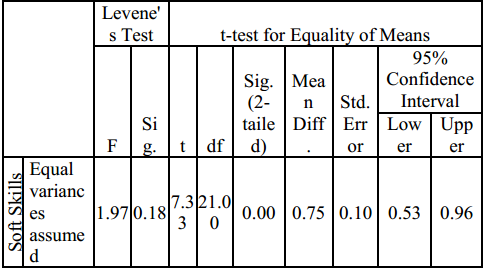
The study strives to generate deep insights regarding the effectiveness of humanities courses that have been integrated into the academic curricula of engineering programs. The opinions of students and teachers surveyed from two leading engineering universities in Bangladesh. The results reflected that humanities aspects have been integrated into the engineering curricula to a limited extent. The t-test results indicated that there are significant variations in the opinion given by the two groups regarding the improvement of students’ soft skills, socio-economic-environmental responsibilities, and mental-thinking process. Students identified that the inability of some teachers to grow interest in the course and relate course contents to the real-life world is hindering desired benefits. Similarly, teachers identified factors such as lack of student interest, inadequate logistics and administrative support, short-sighted curricula, over course load, and low status from the engineering departments are hindering the effectiveness of humanities courses to produce well-rounded engineering graduates. Thus, concerned authorities need to realize the fact that humanities courses are an essential part of a well-rounded education for engineering programs
Conclusion
The present study strives to generate deep insights regarding the effectiveness of humanities courses that are integrated into the academic curricula of engineering programs aims to produce well-balanced engineering students. Extensive literature both from the academic and industry point of views were reviewed to understand the importance and benefits of integrating humanities courses into the engineering curricula. The literature reviews also helped to identify factors that impede the teaching-learning of humanities courses for engineering students. Two groups of respondents (student and teacher) were selected to conduct a questionnaire survey. The study results show that humanities aspects have been integrated into the engineering curricula to a limited extent. The results of the t-test indicate that there are significant variations in the opinion given by the two groups regarding the improvement of students’ soft skills, socio-economic-environmental responsibilities, and mental-thinking process. This means that there is a gap in the teachers’ expectations regarding the benefits of the courses and students’ perception of the benefits they received from the humanities courses. Students opined that the inability of some teachers to grow interested in the course and relate the topic to the real-life world, lack of field visits, and classroom environment are hindering the benefits. As Bangladesh has the vision to become a developed country, it is high time to realize that humanities courses are an essential part of a well-rounded education for engineering programs.
References
[1]
I. Josa and A. Aguado, <em>“Social sciences and humanities in the education of civil engineers: Current status and proposal of guidelines</em>,” J Clean Prod, vol. 311, Aug. 2021, doi
https://doi.org/10.1016/j.jclepro.2021.127489
[3]
A. Barron, D. E. P. Jenkins, and M. Bungard-Neilsen, “The non-technical education of engineers report of a working party, <em>” European Journal of Engineering Education</em>, vol. 2, no. 1, pp. 65–72, Jan. 1977, doi: 3216
https://doi.org/10.1080/0304379770890
[4]
J. D. Lang, S. Cruse, F. D. Mcvey, and J. Mcmasters, “Industry expectations of new engineers: A survey to assist curriculum designers, <em>” Journal of Engineering Education</em>, vol. 88, no. 1. Wiley-Blackwell Publishing Ltd, pp. 43–51, 1999. doi
https://doi.org/10.1002/j.2168-9830.1999.tb00410.x
[6]
D. Gope and A. Gope, <em>“Students and academicians views on the engineering curriculum and industrial skills requirement for a successful job career</em>,” Open education studies, vol. 4, no. 1, pp. 173–186, Jan. 2022, doi: 10.1515/ edu-2022-0011.
[7]
M. A. Moussa, “Development of leadership and communication skills in an experiential learning project management course.”
[9]
S. C. Florman, “Non-technical studies for engineers: The challenge of relevance, <em>” European Journal of Engineering Education</em>, vol. 22, no. 3, pp. 249–258, 1997, doi
https://doi.org/10.1080/03043799708923457
[10]
P. Lambrix and U. Ouchterlony, “Integration of psychology, <em>economics and information technology in an engineering curriculum</em>,” Int J Phytoremediation, vol. 21, no. 1, pp. 162–180, 1999, doi
https://doi.org/10.1076/csed.9.2.162.3809
[11]
D. Basu et al., “Benefits for undergraduates from engagement in an interdisciplinary envi-ronmental monitoring research and education lab.” [Online]. Available: http://www.lewas.centers.vt.edu/dataviewer/
[12]
E. J. Power and J Handley “A best-practice model for integrating interdisciplinarity into the higher education student experience studies in higher education.” vol. 44, no.3, pp.554-570, 2019, doi
https://doi.org/10.1080/03075079.2017.1389876
[13]
S. B. Marcketti and E. E. Karpova, “Getting ready for the real world: Student perspectives on bringing industry collaboration into the classroom.” [Online]. Available: https://www.researchgate.net/publication/264865210
[14]
M. Nissani, <em>“Ten cheers for interdisciplinarity: The case for interdisciplinary knowledge and research</em>,” 1997.
[15]
L. Soibelman, R. Sacks, B. Akinci, I. Dikmen, M. T. Birgonul, and M. Eybpoosh, “Preparing civil engineers for international collaboration in construction management, <em>” Journal of Professional Issues in Engineering Education and Practice</em>, vol. 137, no. 3, pp. 141–150, Jul. 2011, doi
https://doi.org/10.1061/(ASCE)EI.1943-5541.0000044
[16]
M. Handford, J. Van Maele, P. Matous, and Y. Maemura, <em>“Which ‘culture’? A critical analysis of intercultural communication in engineering education</em>,” Journal of Engineering Education, vol. 108, no. 2, pp. 161–177, Apr. 2019, doi
https://doi.org/10.1002/jee.20254
[17]
J. Evans, J. Evans Is Professor, D. Lynch, and D. Lange, “AC 2007-1373: The role of humanities and social sciences in the Civil Engineering body of knowledge.”
[19]
M. Mormina, <em>“Science</em>, Technology and innovation as social goods for development: Rethinking research capacity building from sen’s capabilities approach,” Sci Eng Ethics, vol. 25, no. 3, pp. 671–692, Jun. 2019, doi
https://doi.org/10.1007/s11948-018-0037-1
[20]
M. Decker, N. Weinberger, B. J. Krings, and J. Hirsch, <em>“Imagined technology futures in demand-oriented technology assessment</em>,” J Responsible Innov, vol. 4, no. 2, pp. 177–196, May 2017, doi: . 2017.1360720
https://doi.org/10.1080/23299460
[21]
U. Bechtold, D. Fuchs, and N. Gudowsky, <em>“Imagining socio-technical futures–challenges and opportunities for technology assessment</em>,” J Responsible Innov, vol. 4, no. 2, pp. 85–99, May 2017, doi: 617
https://doi.org/10.1080/23299460.2017.1364
[22]
U. Bechtold, L. Capari, and N. Gudowsky, <em>“Futures of ageing and technology–comparing different actors’ prospective views</em>,” J Responsible Innov, vol. 4, no. 2, pp. 157–176, May 2017, doi: 0721
https://doi.org/10.1080/23299460.2017.136
[23]
K. Eggleson and S. A. Berry, <em>“Macroethics exploration with impact: technological innovators reconsider profound personal and societal questions after viewing the film fixed: The science/fiction of human enhancement</em>,” J Responsible Innov, vol. 2, no. 2, pp. 220–233, May 2015, doi
https://doi.org/10.1080/23299460.2015.1038429
[25]
J. Timmermans, V. Blok, R. Braun, R. Wesselink, and R. Ø. Nielsen, <em>“Social labs as an inclusive methodology to implement and study social change: the case of responsible research and innovation</em>,” J Responsible Innov, pp. 410–426, 2020, doi
https://doi.org/10.1080/23299460.2020.1787751
[26]
B. K. Sovacool, <em>“What are we doing here? Analyzing fifteen years of energy scholarship and proposing a social science research agenda</em>,” Energy Res Soc Sci, vol. 1, pp. 1–29, 2014, doi
https://doi.org/10.1016/j.erss.2014.02.003
[28]
G. Sonetti, O. Arrobbio, P. Lombardi, I. M. Lami, and S. Monaci, <em>“‘“Only social scientists laughed”’: Reflections on social sciences and humanities integration in european energy projects</em>,” Energy Res Soc Sci, vol. 61, Mar. 2020, doi
https://doi.org/10.1016/j.erss.2019.101342
[29]
L. Ingeborgrud et al., <em>“Expanding the scope and implications of energy research: A guide to key themes and concepts from the social sciences and humanities</em>,” Energy research and social science, vol. 63. Elsevier Ltd, May 01, 2020. doi
https://doi.org/10.1016/j.erss.2019.101398
[30]
I. Overland and B. K. Sovacool, <em>“The misallocation of climate research funding</em>,” Energy research and social science, vol. 62. Elsevier Ltd, Apr. 01, 2020. doi
https://doi.org/10.1016/j.erss.2019.101349
[31]
G. Palsson et al., <em>“Reconceptualizing the ‘Anthropos’ in the Anthropocene: Integrating the social sciences and humanities in global environmental change research</em>,” Environ Sci Policy, vol. 28, pp. 3–13, Apr. 2013, doi
https://doi.org/10.1016/j.envsci.2012.11.004
[32]
L. Krabbenborg, <em>“Creating inquiry between technology developers and civil society actors: Learning from experiences around nanotechnology</em>,” Sci Eng Ethics, vol. 22, no. 3, pp. 907–922, Jun. 2016, doi
https://doi.org/10.1007/s11948-015-9660-2
[33]
G. M. Glasford, <em>“The focus of engineering education: The student</em>, the profession, and society,” 1970.
[34]
A. Barron, D. E. P. Jenkins, and M. Bungard-Neilsen, “The non-technical education of engineers’ report of a working party, <em>” European Journal of Engineering Education</em>, vol. 2, no. 1, pp. 65–72, Jan. 1977, doi
https://doi.org/10.1080/03043797708903216
[35]
W. W. Daniel, <em>Biostatistics: a foundation for analysis in the health sciences. J. Wiley & Sons</em>, 2009.