Design and Modelling of a Coaxial Probe Fed Two-Port Dual-Band Antenna for Wireless Communication
Dr. Md. Masud Rana, Md. Ariful Islam
Abstract
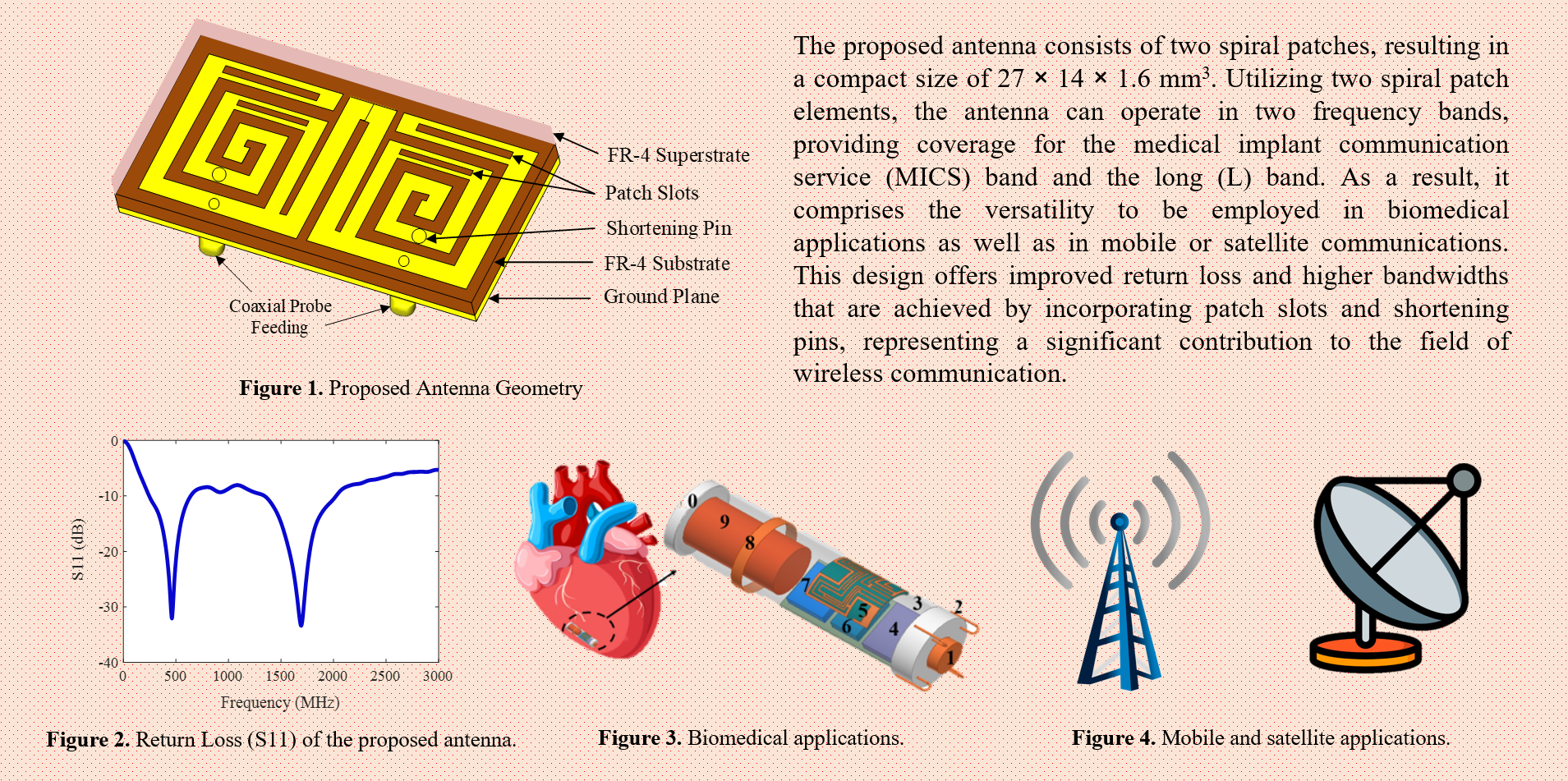
This paper presents a dual-band antenna with coaxial probe feeding for wireless applications. The antenna consists of two spiral patches, resulting in a compact size of 27 × 14 × 1.6 mm3. Utilizing two spiral patch elements, the antenna can operate in two frequency bands, 241-641 MHz and 1.33-2.01 GHz, providing coverage for the medical implant communication service (MICS) band and the long (L) band. As a result, it comprises the versatility to be employed in biomedical applications as well as in mobile or satellite communications. This design offers improved return loss and higher bandwidths that are achieved by incorporating patch slots and shortening pins, representing a significant contribution to the field of wireless communication. The obtained return losses are -31.98 dB and -33.16 dB at the resonant frequencies of 459 MHz and 1.68 GHz, respectively. The gain values at these resonant frequencies are -45.6 dB and -18.2 dB.
Conclusion
A two-port coaxial probe fed spiral shaped dual-band antenna for wireless communication is introduced in this work. The proposed antenna is designed to operate at two different frequencies: 459 MHz, which is close to the MICS band, and 1.68 GHz, in the L band. It offers bandwidths of 416 MHz and 800 MHz for each resonant frequency, respectively. The antenna is made on an FR-4 substrate and consists of two symmetrical spiral elements, measuring 27 × 14 × 1.6 mm3 in total. The coaxial probe feeding technique is used for excitation. This antenna demonstrates low power loss because of the improved return losses, which are - 31.98 dB and - 33.16 dB at their respective resonant frequencies. Patch slots and shortening pins are incorporated in the spiral patches to improve their return loss and increase bandwidths, representing a significant contribution to the field of dual-band antenna design for wireless communication. Given the capability of the proposed antenna to operate within both the MICS band and L band, it possesses the versatility to be employed for applications in biomedical contexts, as well as in mobile or satellite communications. At the resonant frequencies, gains of - 45.6 dB and - 18.2 dB are finally realized with radiation efficiencies of -49.18 dB and -20.99 dB, respectively. Due to the limitations of resources and lab facilities, the proposed antenna could not be fabricated. Thus, the experimental results could not be obtained.
References
[1]
A. G. Miquel, “Antenna design and characterization for biomedical applications,” University of Barcelona, Barcelona, Spain, Oct. 2018.
[2]
A. Zakaria et al., “Design and Modeling of Ultra-Compact Wideband Implantable Antenna for Wireless ISM Band, <em>” Bioengineering</em>, vol. 10, no. 2, pp. 216–216, Feb. 2023.
[3]
A. M. Mozi, D. S. A. Damit, and Z. Faiza, “Rectangular spiral microstrip antenna for WLAN application, <em>” IEEE Control and System Graduate Research Colloquium (ICSGRC)</em>, Selangor, Malaysia, Jul. 2012.
[4]
S. K. Padhi, N. C. Karmakar, C. L. Law, and S. Aditya, “A dual polarized aperture coupled circular patch antenna using a c-shaped coupling slot,” IEEE Transactions on Antennas and Propagation, vol. 51, no. 12, pp. 3295–3298, Dec. 2003.
[5]
W.-C. Liu, C. Wu, and Y. Dai, “Design of Triple-Frequency Microstrip-Fed Monopole Antenna Using Defected Ground Structure,” IEEE Transactions on Antennas and Propagation, vol. 59, no. 7, pp. 2457–2463, May 2011.
[6]
A. Arif, M. Zubair, M. Ali, M. U. Khan, and M. Q. Mehmood, “A Compact, Low-Profile Fractal Antenna for Wearable On-Body WBAN Applications,” IEEE Antennas and Wireless Propagation Letters, vol. 18, no. 5, pp. 981–985, May 2019.
[7]
Z. Duan, Y.-X. Guo, R.-F. Xue, M. Je, and D.-L. Kwong, “Differentially Fed Dual-Band Implantable Antenna for Biomedical Applications,” IEEE Transactions on Antennas and Propagation, vol. 60, no. 12, pp. 5587–5595, Dec. 2012.
[8]
P. Soontornpipit, C. M. Furse, and Y. C. Chung, “Design of Implantable Microstrip Antenna for Communication with Medical Implants,” IEEE Transactions on Microwave Theory and Techniques, vol. 52, no. 8, pp. 1944–1951, Aug. 2004.
[9]
Md. S. Islam, K. P. Esselle, D. Bull, and P. M. Pilowsky, <em>“Converting a Wireless Biotelemetry System to an Implantable System Through Antenna Redesign</em>,” IEEE Transactions on Microwave Theory and Techniques, vol. 62, no. 9, pp. 1890–1897, Sep. 2014.
[10]
F.-J. Huang, C.-M. Lee, C.-L. Chang, L.-K. Chen, T.-C. Yo, and C.-H. Luo, “Rectenna Application of Miniaturized Implantable Antenna Design for Triple-Band Biotelemetry Communication,” IEEE Transactions on Antennas and Propagation, vol. 59, no. 7, pp. 2646–2653, Jul. 2011.
[11]
V. Kaim, B. K. Kanaujia, S. Kumar, H. C. Choi, K. W. Kim, and K. Rambabu, “Ultra-Miniature Circularly Polarized CPW-Fed Implantable Antenna Design and its Validation for Biotelemetry Applications,” Scientific Reports, vol. 10, no. 1, Apr. 2020.
[12]
Z. A. Dayo et al., <em>“A novel compact broadband and radiation efficient antenna design for medical IoT healthcare system</em>,” Mathematical Biosciences and Engineering, vol. 19, no. 4, pp. 3909–3927, 2022.
[13]
A. Y. I. Ashyap et al., “Robust and Efficient Integrated Antenna With EBG-DGS Enabled Wide Bandwidth for Wearable Medical Device Applications,” IEEE Access, vol. 8, pp. 56346-56358, 2020.
[14]
A. Zakaria et al., “Design and Modeling of Ultra-Compact Wideband Implantable Antenna for Wireless ISM Band, <em>” Bioengineering</em>, vol. 10, no. 2, pp. 216–216, Feb. 2023.
[15]
Z. Huang, H. Wu, S. S. Mahmoud, and Q. Fang, “Design of a Novel Compact MICS Band PIFA Antenna for Implantable Biotelemetry Applications,” Sensors, vol. 22, no. 21, p. 8182, Oct. 2022.
[16]
M. Palandoken, “Compact Bioimplantable MICS and ISM Band Antenna Design for Wireless Biotelemetry Applications, <em>” Radioengineering</em>, vol. 26, no. 4, pp. 917–923, Dec. 2017.
[17]
Y. Fan, H. Liu, X. Liu, Y. Chen, Z. Li, and M. M. Tentzeris, “Novel coated differentially fed dual‐band fractal antenna for implantable medical devices,” IET Microwaves Antennas & Propagation, vol. 14, pp. 199–208, 2019.
[18]
V. R. Gudivada et al., “Dual-Band Pattern Diversity Liquid Antenna with Passive Beam-Steering of the Broadside Modes," IET Microwaves, Antennas & Propagation, 2024.
[19]
W. Xia, K. Saito, M. Takahashi, and K. Ito, “Performances of an Implanted Cavity Slot Antenna Embedded in the Human Arm,” IEEE Transactions on Antennas and Propagation, vol. 57, no. 4, pp. 894–899, Apr. 2009.
[20]
A. Basir and H. Yoo, <em>“A Stable Impedance-Matched Ultrawideband Antenna System Mitigating Detuning Effects for Multiple Biotelemetric Applications</em>,” IEEE Transactions on Antennas and Propagation, vol. 67, no. 5, pp. 3416–3421, May 2019.
[21]
Y. Fan, H. Liu, X. Liu, Y. Chen, Z. Li, and M. M. Tentzeris, “Novel coated differentially fed dual‐band fractal antenna for implantable medical devices,” IET Microwaves Antennas & Propagation, vol. 14, no. 2, pp. 199–208, Nov. 2019.
[22]
V. Kaim, B. K. Kanaujia, and K. Rambabu, <em>“Quadrilateral Spatial Diversity Circularly Polarized MIMO Cubic Implantable Antenna System for Biotelemetry</em>,” IEEE Transactions on Antennas and Propagation, vol. 69, no. 3, pp. 1260–1272, Mar. 2021.
[23]
J. Zhang et al., “A Compact Dual-Band Implantable Antenna for Wireless Biotelemetry in Arteriovenous Grafts,” IEEE Transactions on Antennas and Propagation, vol. 71, no. 6, pp. 4759–4771, Jun. 2023.
[24]
C. Liu, Y.-X. Guo, and S. Xiao, <em>“Circularly Polarized Helical Antenna for ISM-Band Ingestible Capsule Endoscope Systems</em>,” IEEE Transactions on Antennas and Propagation, vol. 62, no. 12, pp. 6027–6039, Dec. 2014.
[25]
H. Li, Y.-X. Guo, C. Liu, S. Xiao, and L. Li, “A Miniature-Implantable Antenna for MedRadio-Band Biomedical Telemetry,” IEEE Antennas and Wireless Propagation Letters, vol. 14, pp. 1176–1179, 2015.
[26]
S. A. A. Shah and H. Yoo, <em>“Scalp-Implantable Antenna Systems for Intracranial Pressure Monitoring</em>,” IEEE Transactions on Antennas and Propagation, vol. 66, no. 4, pp. 2170–2173, Apr. 2018.