Evaluation of the Antioxidative Activities of Gamma-Oryzanol and Tocotrienol Rich Fractions Extracted from Rice Bran and Bran Oil
Aktarun Nahar, Md. Abbas Ali, Md. Shamsul Alam, Bijoy Maitra
Abstract
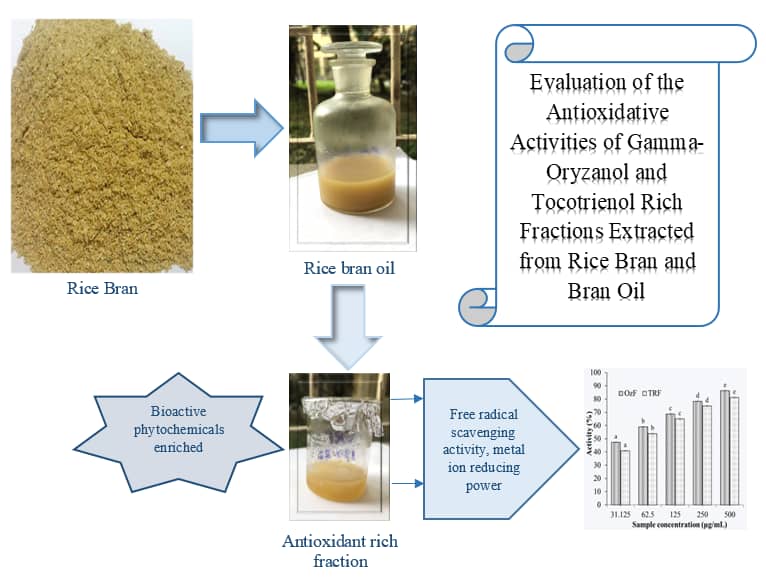
The current study determined the antioxidant activities of g-oryzanol rich fraction (OzF) and tocotrienol rich faction (TRF) derived from rice bran. Total phenolic content (TPC), total flavonoid content (TFC) and oryzanol content of OzF and TRF were examined. We explored hydrogen peroxide, hydroxyl radical, and 2, 2-diphenyl-1-picryl hydrazyl (DPPH) radical scavenging and reducing power assays. OzF and TRF's total antioxidant activity (TAA) were investigated using conventional procedure. Total antioxidant activity of OzF was 361.29±6.17 AAE mg/g and TRF was 273.88±5.31 AAE mg/g. Additionally, TPC and TFC of TRF (189.83±4.37 mg GAE/g and 97.64±0.22 CE mg/g respectively) were lower than those of OzF (256.34±7.68 mg GAE/g and 118.31±0.42 CE mg/g, respectively). DPPH, H2O2, hydroxyl radicals scavenging activities and reducing power were present in all concentrations of the extracts, the effects being dose-dependent. The current study provided crucial information for the development of food products with high antioxidant efficacy by utilizing TRF and OzF.
Conclusion
The study's antioxidative findings unequivocally establish that, fractions rich in g-oryzanol and tocotrienol have the power of scavenging or inhibiting free radicals, similar to a primary antioxidant reacting with free radicals. This could mitigate the harm that free radicals do to the body. Strong hydrogen-donating capabilities and efficaciousness as scavengers of H2O2 and other free radicals can be credited for the extracts' diverse antioxidant methods. In addition, the extracts get engaged in competition with DPPH radicals and inhibits the production of chromogen. As a result, OzF and TRF both exhibit strong antioxidant activity against a variety of in vitro oxidative structures, making them valuable as prospective dietary supplements as well as easily accessible sources of naturally occurring antioxidants. A compound's reducing capacity may be a useful predictor of its ability to exert antioxidant action and it is easily assumed that, these antioxidants will be able to prevent the development of lipid peroxides. According to the study, antioxidant-rich fractions' reducing capacity gets enhanced in proportion to concentration. As compared to tocotrienol rich fraction, all concentrations of g-oryzanol rich fraction displayed a strong potential to serve as an antioxidant; this is possibly because of the high phenolic content of the former, which was discovered through the analysis of the samples' bioactive phytochemicals. The samples are thought to be able to work competitively and synergistically against free radicals. Therefore, free radicals can be stabilized or neutralized by antioxidant-rich components before they damage cells.
References
[1]
I. Gülçin, "Antioxidants and antioxidant methods: an updated overview," Archives of Toxicology, vol. 94, 2020.
[2]
J. Bardhan, R. Chakraborty and U. Raychaudhuri, "Quality Enhancement of Mustard Oil by Tocotrienol Rich Fraction from Rice Bran Oil, <em>" International Journal of Food Properties</em>, vol. 17, pp. 2312-2321, 2014.
[3]
M. Saito, H. Sakagami and S. Fujisawa, "Cytotoxicity and apoptosis induction by butylated hydroxyanisole (BHA) and butylated hydroxytoluene (BHT), <em>" Anticancer Research</em>, vol. 23, pp. 4693–4701, 2002.
[4]
S. Iqbal, M. Bhanger and F. Anwar, "Antioxidant properties and components of bran extracts from selected wheat varieties commercially available in Pakistan, <em>" LWT - Food Science and Technology</em>, vol. 40, pp. 361-367, 2007.
[5]
B. Raja and V. Pugalendi, "Evaluation of antioxidant activity of Melothria maderaspatana in vitro, <em>" Central European Journal of Biology</em>, vol. 5, pp. 224-230, 2010.
[6]
Z. Cheong and X. Xu, Rice Bran and Rice Bran Oil, 1st ed., Elsevier: AOCS Press, 2019, pp.19-54.
[7]
S. Jaiswal, S. Pradhan, M. Patel, M. Naik and S. Naik, "Rice Bran Oil Distillate, a Choice for Gamma-Oryzanol: Separation and Oxidative Stability Study, <em>" Journal of Food Research</em>, vol. 4, pp. 36, 2015.
[8]
M. Joshi, R. Kaur, P. Kanwar, G. Dhiman, G. Sharma, S. Lata, K. Tilak, N. Gupta and T. Mishra, "To evaluate antioxidant activity of γ– oryzanol extracted from rice bran oil, <em>" International Journal of Life Science and Pharma Research</em>, vol. 6, pp. 17-25, 2016.
[9]
J. Tao, L. Liu, Q. Ma, K. Ma, Z. Chen, F. Ye, L. Lei and G. Zhao, "Effect of γ-oryzanol on oxygen consumption and fatty acids changes of canola oil," LWT, vol. 160, pp. 113275, 2022.
[10]
Z. Xu and J. S. Godber, "Comparison of supercritical fluid and solvent extraction methods in extracting γ-oryzanol from rice bran, <em>" Journal of the American Oil Chemists' Society</em>, vol. 77, pp. 547-551, 2000.
[11]
N. Prasad, R. Sanjay, M. Shravya, M. Vismaya, and S. Nanjunda, <em>"Health benefits of rice bran - a review</em>," Journal of Nutrition & Food Sciences, vol. 01, pp. 1-8, 2015.
[12]
M. Sohail, A. Rakha, M. Butt, M. Iqbal and S. Rashid, <em>"Rice bran nutraceutics: A comprehensive review</em>," Critical Reviews in Food Science and Nutrition, vol. 57, pp. 3771-3780, 2017.
[13]
Y. P. Pal and A. P. Pratap, "Rice bran oil: a versatile source for edible and industrial applications, <em>" Journal of Oleo Science</em>, vol. 66, pp. 551-556, 2017.
[14]
M. Fiume, "Safety assessment of tocopherols and tocotrienols as used in cosmetics status, <em>" Cosmetic ingredient review</em>, vol. 20036, pp. 1–38, 2014.
[15]
R. Singanusong and U. Garba, "Chapter 5 - Micronutrients in Rice Bran Oil," Rice Bran and Rice Bran Oil, L.-Z. Cheong and X. Xu: AOCS Press, 2019, pp. 125-158.
[16]
V. Roginsky and E. Lissi, <em>"Review of methods to determine chain breaking antioxidant activity in food</em>," Food Chemistry, vol. 92, p. 235–254, 2005.
[17]
A. Boligon, "Technical Evaluation of Antioxidant Activity," Medicinal Chemistry, vol. 4, 2014
[18]
A. Balaraman, J. Singh, S. Dash, A. Naskar and T. Maity, "Evaluation of Antioxidant Activity of Different Fractions of Melothria maderaspatana, <em>" Asian Journal of Chemistry</em>, vol. 23, pp. 2207-2211, 2011.
[19]
N. Lakkakula, M. Lima and T. Walker, "Rice bran stabilization and rice bran oil extraction using ohmic heating, <em>" Bioresource Technology</em>, vol. 92, pp. 157–161, 2004.
[20]
S. Siddiqui, M. Khan and W. Siddiqui, <em>"Comparative hypoglycemic and nephroprotective effects of tocotrienol rich fraction (TRF) from palm oil and rice bran oil against hyperglycemia induced nephropathy in type 1 diabetic rats</em>," Chemico-Biological Interactions, vol. 188, pp. 651–658, 2010.
[21]
M. Skerget, P. Kotnik, M. Hadolin, A. Hras, M. Simonic and Z. Knez, "Phenols, proanthocyanidins, <em>flavones and flavonols in some plant materials and their antioxidant activities</em>," Food chemistry, vol. 89, pp. 191-198, 2005.
[22]
S. Wu and L. Ng, "Antioxidant and free radical scavenging activities of wild bitter melon (Momordica charantia Linn. var. abbreviata Ser.) in Taiwan, <em>" LWT- Food Science and Technology</em>, vol. 41, pp. 323-330, 2008.
[23]
G. Seetharamaiah and J. Pravakar, "Oryzanol content of Indian rice bran oil and its extraction from soap stock, <em>" Journal of Food Science and Technology</em>, vol. 23, pp. 270-273, 1986.
[24]
K. Adom, M. Sorrells and R. Liu, "Phytochemicals and antioxidant activity of milled fractions of different wheat varieties, <em>" Journal of Agricultural and Food Chemistry</em>, vol. 53, pp. 2297-2306, 2005.
[25]
C. Negro, L. Tommasi and A. Miceli, "Phenolic compounds and antioxidative activity from red grape marc extracts, <em>" Bioresource Technology</em>, vol. 87, pp. 431-444, 2003.
[26]
R. Ruch, S. Cheng and J. Klaunig, "Prevention of cytotoxicity and inhibition of intercellular communication by antioxidant catechins isolated from Chinese green tea," Carcinogen, vol. 10, pp. 1003-1008, 1989.
[27]
N. Smirnoff and Q. Cumbes, "Hydroxyl radical scavenging activity of compatible solutes," Phytochemistry, vol. 28, pp. 1057-1060, 1989.
[28]
D. Atmani, N. Chaher, M. Berboucha, K. Ayouni, H. Lounis, H. Boudaoud, N. Debbache and D. Atmani, "Antioxidant capacity and phenol content of selected Algerian medicinal plants," Food Chemistry, vol. 112, pp. 303-309, 2009.
[29]
T. Guo, L. Wei, J. Sun, C. L. Hou and L. Fan, "Antioxidant activities of extract and fractions from Tuber indicum Cooke & Massee," Food Chemistry, vol. 127, pp. 1634-1640, 2011.
[30]
M. Ali, A. Islam, N. Othman, A. Noor and M. Ibrahim, "Effect of rice bran oil addition on the oxidative degradation and fatty acid composition of soybean oil during heating," Acta Scientiarum Polonorum Technologia Alimentaria, vol. 18, pp. 427-438, 2019.
[31]
S. Ali, F. Anwar, M. Manzoor and J. Bajwa, "Evaluation of the antioxidant activity of rice bran extracts using different antioxidant assays," Grasas y Aceites, vol. 57, pp. 328-335, 2006.
[32]
M. Bhanger, S. Iqbal, F. Anwar, M. Imran, M. Akhtar and M. Zia-ul-Haq, "Antioxidant potential of rice bran extracts and its effects on stabilisation of cookies under ambient storage, <em>" International Journal of Food Science & Technology</em>, vol. 43, pp. 779-786, 2007.
[33]
X. Xiong, M. Li, J. Xie, Q. Jin, B. Xue and T. Sun, "Antioxidant activity of xanthan oligosaccharides prepared by different degradation methods," Carbohydrate Polymers, vol. 92, pp. 1166-1171, 2013.
[34]
J. Imlay and S. Linn, "DNA damage and oxygen radical toxicity, <em>" Science</em>, vol. 240, pp. 1302- 1309, 1988.
[35]
R. El-haskoury, N. Al-Waili, Z. Kamoun, M. Makni, H. Al-Waili and B. Lyoussi, <em>"Antioxidant activity and protective effect of carob honey in CCl4-induced kidney and liver injury</em>," Archives of Medical Research, vol. 49, no. 5, pp. 306-313, 2018.
[36]
M. Olszowy, "What is responsible for antioxidant properties of polyphenolic compounds from plants?," Plant Physiology and Biochemistry, vol. 144, pp. 135-143, 2019.
[37]
R. Colombo, G. Moretto, M. Barberis, I. Frosi, and A. Papetti, "Rice Byproduct Compounds: From Green Extraction to Antioxidant Properties," Antioxidants, vol. 13, p. 35, 2024.
[38]
S. Yousuf, S. Shabir, S. Kauts, T. Minocha, A. Obaid, A. Khan, A. Mujalli, Y. Jamous, S. Almaghrabi, B. Baothman, A. Hjazi , S. Singh, E. Vamanu and M. Singh, "Appraisal of the Antioxidant Activity, Polyphenolic Content, and Characterization of Selected Himalayan Herbs: Anti-Proliferative Potential in HepG2 Cells," Molecules, vol. 27, p. 8629, 2022.
[39]
M. Ali, M. Islam, J. Hossain and M. Ibrahim, "Antioxidative evaluation of solvent extracts and fractions of oil refining steps from rice bran, <em>" International Food Research Journal</em>, vol. 26, pp. 791-799, 2019.