Dynamics of Urban Heat Wave and Its Impacts on Slum Communities: A Case Study of Rajshahi City Corporation, Bangladesh
Md. Shakil Ar Salan
Abstract
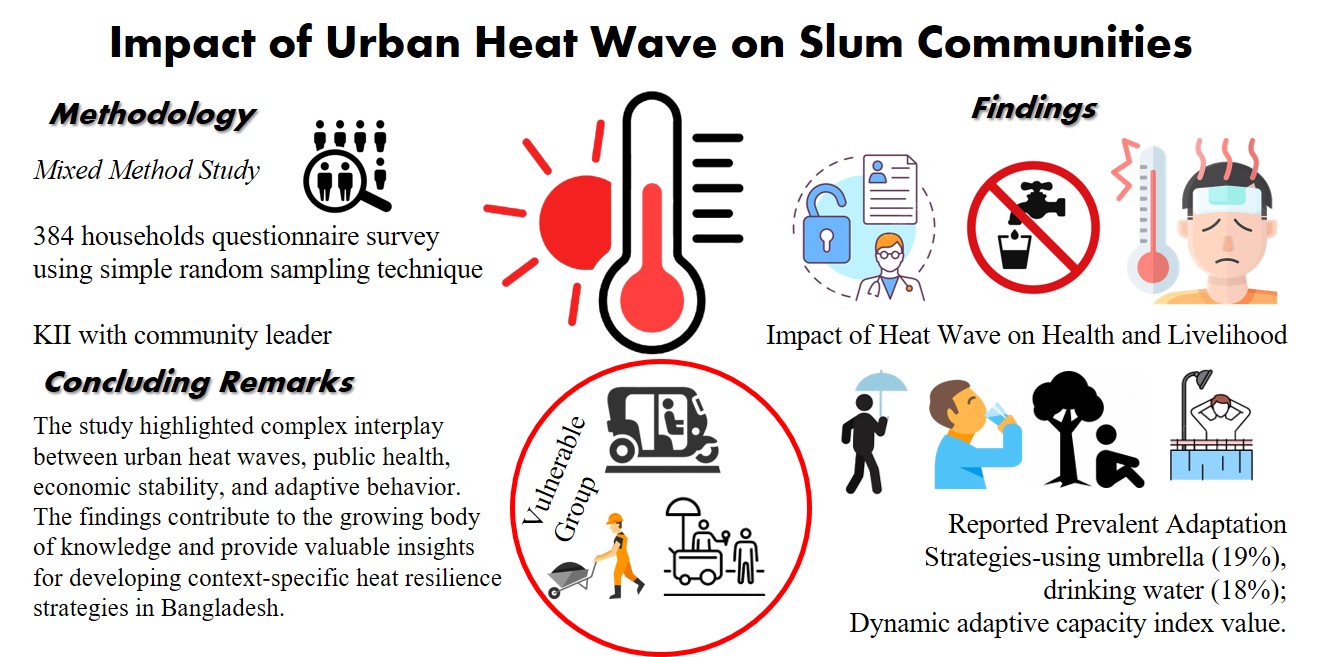
A severe heatwave is impacting Bangladesh, with Rajshahi’s underserved populations being particularly vulnerable. Urban slum residents, such as auto-rickshaw drivers, construction laborers, and street vendors, face heightened exposure to heat-related risks. This study examines perceptions of heatwaves and the adaptive capacities of these vulnerable groups, utilizing a mixed-methods approach that includes key informant interviews, household surveys, and secondary data analysis. Findings indicate that high temperatures and heatwaves are significant concerns for most respondents, with excessive sweating and dehydration being common health challenges that disrupt daily life. Coping strategies include using fans and wearing damp clothing to adapt routines. Variations in physical, natural, financial, human, and social capital influence the community’s adaptive capacities, highlighting targeted and effective urban development policies. The insights from this study aim to inform climate adaptation strategies, fostering proactive responses and shaping policies at both regional and national levels to manage heat extremes in Rajshahi’s informal settlements.
Conclusion
This study provides valuable insights into the perceptions, impacts, and coping strategies related to urban heat waves in Rajshahi City, Bangladesh. The findings reveal a high level of awareness regarding increasing temperatures. This aligns with global trends of rising temperatures in urban areas, as documented in numerous studies [8, 9]. The identification of heat hotspots within urban settings, including living spaces, transport modes, city centers, and worksites, underscores the need for targeted interventions in these areas. The low perception of open spaces/parks as heat hotspots suggests potential opportunities for urban green space development as a heat mitigation strategy. This finding is consistent with research highlighting the cooling effects of urban green spaces [1, 10].
Health impacts associated with heat waves, such as excessive sweating, dehydration, and heat stroke, emphasize the public health implications of rising temperatures. The economic burden of these health issues is evident. This highlights the need for preventive measures and improved healthcare access during extreme heat events [2]. The diverse coping strategies employed by residents, including increasing working hours, reducing other costs, and seeking loans, reflect the economic challenges posed by heat waves. The finding that 35.9% of respondents experienced income reductions of 25% to 50% underscores the significant economic impact of extreme heat on vulnerable populations. This aligns with research on the disproportionate effects of climate change on low-income communities [10, 15, 21]. The prevalence of behavioural adaptations, such as modifying daily activities and employing physical cooling strategies (e.g., using fans, drawing curtains), demonstrates the community's resilience in the face of extreme heat. However, the reliance on simple, low-cost measures suggests limitations in access to more advanced cooling technologies. This highlights the need for affordable and sustainable cooling solutions in urban planning and development. The variations in adaptive capacity scores among the communities indicate differing levels of preparedness and ability to respond to challenges. This supports the notion that adaptive capacity is influenced by multiple factors and varies significantly even within similar socio-economic contexts [8].
These findings have several implications for policy and practice such as: urban planning should prioritize heat-resilient design, incorporating green spaces and passive cooling strategies in buildings and public areas, public health interventions should focus on raising awareness about heat-related health risks and promoting effective coping strategies, investment in sustainable and affordable cooling technologies is crucial to enhance resilience, particularly for low-income communities. In conclusion, this study underscores the complex interplay between urban heat waves, public health, economic stability, and adaptive behaviour in Rajshahi City. The findings contribute to the growing body of knowledge on climate change impacts in urban settings and provide valuable insights for developing context-specific heat resilience strategies in Bangladesh and similar developing urban contexts. Further research is needed to explore the long-term impacts of heat adaptation strategies on health, productivity, and social dynamics.
References
[1]
C. Demidchuk, D. G. Santoyo, G. G. Cushman, J. W. L. Eng Luz, A. Gil, and M. R. Blessing, “Sustainable cooling and heat adaptation: Cool roofs as a potential strategy for Dhaka, Bangladesh EE Practicum Report,” 2019.
[3]
Md. S. Salan and Md. S. Reza, “CLIMATE CHANGE AND SEASONAL BEHAVIORAL DISRUPTION OF CLIMATE PARAMETERS: A STUDY OF RAJSHAHI CITY, <em>” in Proceedings</em>, International Conference on Disaster Risk Management, 2019. [Online]. Available: https://www.researchgate.net/publication/330369540
[4]
A. Subedi, T. Islam, R. Khan, Dr. A. Hassan, and S. Hogesteeger, “Identification of Heat Threshold and Heat Hotspots,” 2021.
[5]
S. Shahid, X. J. Wang, S. Bin Harun, S. B. Shamsudin, T. Ismail, and A. Minhans, “Climate variability and changes in the major cities of Bangladesh: observations, possible impacts and adaptation,” Reg Environ Change, vol. 16, no. 2, pp. 459–471, Feb. 2016, doi
https://doi.org/10.1007/s10113-015-0757-6
[6]
A. L. Hass, J. D. Runkle, and M. M. Sugg, <em>“The driving influences of human perception to extreme heat: A scoping review</em>,” Environ Res, vol. 197, p. 111173, Jun. 2021, doi
https://doi.org/10.1016/j.envres.2021.111173
[8]
K. Laranjeira, F. Göttsche, J. Birkmann, and M. Garschagen, “Heat vulnerability and adaptive capacities: findings of a household survey in Ludwigsburg, BW, Germany,” Clim Change, vol. 166, no. 1–2, May 2021, doi
https://doi.org/10.1007/s10584-021-03103-2
[9]
M. Santamouris, <em>“Recent progress on urban overheating and heat island research. Integrated assessment of the energy</em>, environmental, vulnerability and health impact. Synergies with the global climate change,” Energy Build, vol. 207, Jan. 2020, doi
https://doi.org/10.1016/j.enbuild.2019.109482
[10]
M. Guardaro, M. Messerschmidt, D. M. Hondula, N. B. Grimm, and C. L. Redman, “Building community heat action plans story by story: A three neighborhood case study,” Cities, vol. 107, Dec. 2020, doi
https://doi.org/10.1016/j.cities.2020.102886
[11]
M. Macchi, “Framework for Community- Based Climate Vulnerability and Capacity Assessment in Mountain Areas,” pp. 1–32, 2011, [Online]. Available: papers3://publication/uuid/A244F3EF-758B-44EB-B2C2-0876A0AAE39A
[12]
J. P. Rafferty, “Heatwave.” 2018.
[13]
C. O. N. Moser, “Reassessing urban poverty reduction strategies: The asset vulnerability framework.”
[14]
M. Roy, D. Hulme, and F. Jahan, “Contrasting adaptation responses by squatters and low-income tenants in Khulna, Bangladesh,” Environ Urban, vol. 25, no. 1, pp. 157–176, Apr. 2013, doi
https://doi.org/10.1177/0956247813477362
[15]
D. Archer, W. Marome, B. Natakun, P. Mabangyang, and N. Phanthuwongpakdee, “The role of collective and individual assets in building urban community resilience, <em>” International Journal of Urban Sustainable Development</em>, vol. 12, no. 2, pp. 169–186, May 2020, doi
https://doi.org/10.1080/19463138.2019.1671425
[16]
D. Saez Ujaque, E. Roca, R. de Balanzó Joue, P. Fuertes, and P. Garcia-Almirall, “Resilience and urban regeneration policies. Lessons from community-led initiatives. the case study of canfugarolas in Mataro (Barcelona),” Sustainability (Switzerland), vol. 13, no. 22, Nov. 2021, doi
https://doi.org/10.3390/su132212855
[17]
R. Mcmillan, J. Kocsis, and A. Daniere, “Rights, justice and climate resilience: lessons from fieldwork in urban Southeast Asia,” Environ Urban, vol. 34, no. 1, pp. 170–189, Apr. 2022, doi
https://doi.org/10.1177/09562478211035644
[18]
T. Atmaja, N. Kusyati, and K. Fukushi, “Community Resilience and Empowerment through Urban Farming Initiative as Emergency Response, <em>” in IOP Conference Series: Earth and Environmental Science</em>, IOP Publishing Ltd, Aug. 2021. doi
https://doi.org/10.1088/1755-1315/799/1/012014
[19]
M. Z. Hossain and M. M. Rahman, “Climate change vulnerability and resilience of urban poor in Khulna, Bangladesh: the role of asset-based community development approach, <em>” International Journal of Urban Sustainable Development</em>, vol. 13, no. 2, pp. 131–147, 2021, doi
https://doi.org/10.1080/19463138.2020.1828891
[20]
T. Tabassum, Fatema-Tuz-Zohora, S. Manzoor-Al-Islam, and N. Tahsin, “Developing Evidence on Water, Sanitation and Hygiene Facilities in the Climate Vulnerable Slums through WASH Poverty Index: A Case Study on Selected Slums in Rajshahi City Corporation, Bangladesh,” pp. 1–16, 2022, [Online]. Available: https://europepmc.org/article/ppr/ppr589285
[21]
F. Z. Shabrina, I. Meilano, W. Windupranata, and N. R. Hanifa, “Measure coastal disaster resilience using community disaster resilience index (CDRI) in Mentawai Island, Indonesia,” AIP Conf Proc, vol. 1987, 2018, doi
https://doi.org/10.1063/1.5047365
[22]
P. Lawrence and J. Meigh, <em>“The Water Poverty Index : an International Comparison Keele Economics Research Papers</em>,” vol. 2002, no. October 2002, 2003.
[23]
S. Naher and B. Khulna, “Problems and Prospects of Adaptive Capacity of Climate Vulnerable People: A Household Level Study of Padmapukur Union on Shyamnagor Upazila, Satkhira,” BSS (Hons.) in Economics Thesis. Khulna …, pp. 1–66, 2012, [Online]. Available: https://www.academia.edu/download/61100502/Sabekun_Naher_Final_BSS_Thesis20191102-44075-1qz2u9v.pdf