Fabrication and Characterization of Dye-Sensitized Solar Cells Using Natural Dyes
Sakib Hossen, Ankita Paul, Md. Faruk Hossain
Abstract
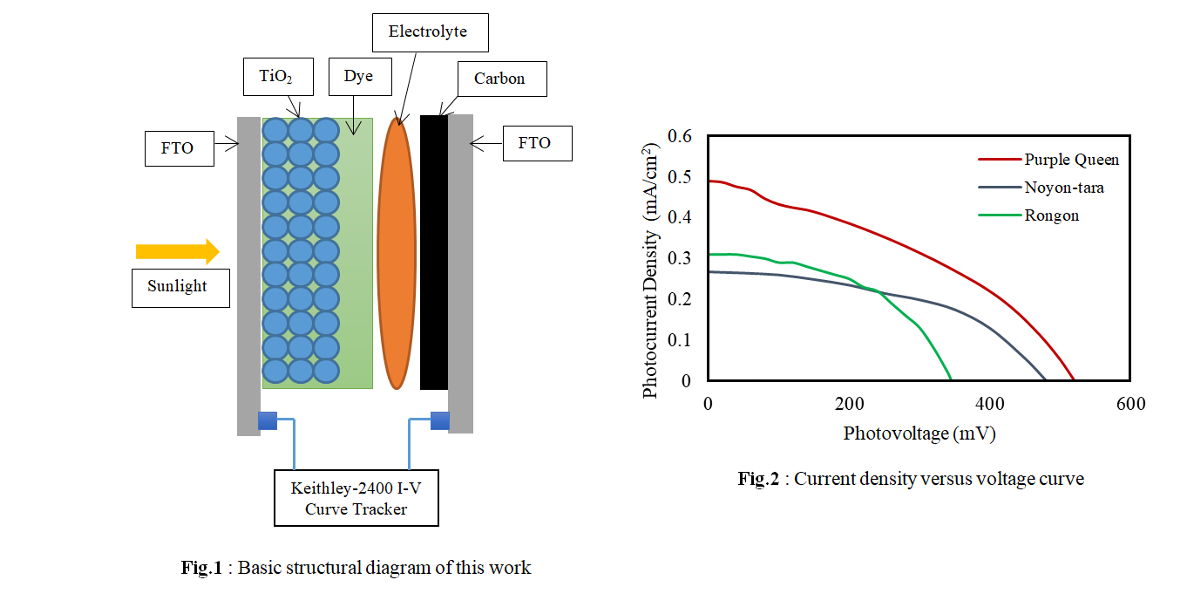
This work reflects the fabrication and characterization techniques of Dye-Sensitized Solar Cells (DSSCs). The DSSCs is one of the foremost promising 3rd generation solar cell due to the greener energy production. The goal of this work was to create a low cost TiO2-based dye-sensitized solar cells (DSSCs) with a carbon counter electrode and natural dyes as sensitizing agent. The extracted dye components were shown a notable absorbance in between 400nm to 700nm wavelength in UV-Vis spectrophotometer. The photoelectrochemical characteristics of the DSSCs were then characterized under AM 1.5 illumination of solar simulator. The open circuit voltages and short circuit currents density were achieved 0.52 V, 0.44V, 0.345V and 0.531 mA/𝑐𝑚2, 0.267 mA/𝑐𝑚2, 0.31 mA/𝑐𝑚2 for Tradescantia pallida, Jungle geranium, and Catharanthus roseus based DSSCs respectively. Whereas the efficiency was 0.095%, 0.0611%, 0.0528% respectively.
Conclusion
The incorporation of natural pigments in DSSCs has unveiled substantial potential for enhancing solar energy harness. This investigation has expounded upon the intricate nexus between the pigment derived from organic sources, such as Tradescantia pallida (Purple Queen) leaves, Catharanthus roseus (Noyontara) flowers, and Jungle Geranium (Rongon) flowers and the photoelectrochemical performance within the solar cell. The fusion of DSSC, catalysed by the aforenamed pigment, has exhibited notable photovoltaic characteristics. The observed conversion efficiency of 0.095% for Purple Queen leaves-based DSSC, 0.0611% Catharanthus roseus (Noyontara) flowers-based DSSC, and 0.0528% for Jungle Geranium (Rongon) flowers-based DSSC validates the feasibility of employing natural pigments as sensitizing agents in DSSCs. Higher efficiency and stability can be obtained by using solid state electrolyte and Platinum counter electrode. This materials couldn’t be used in this work due to unavailability of these materials in the lab.
References
[1]
S. Shalini, R. B. Prabhu, S. Prasanna, T. K. Mallick, and S. Sundaram, <em>“Review on natural dye-sensitized solar cells: Operation</em>, materials and methods, <em>” Renewable & Sustainable Energy Reviews</em>, vol. 51, pp. 1306–1325, Nov. 2015.
[2]
A. Olea, G. Ponce, and P. J. Sebastian, “Electron transfer via organic dyes for solar conversion, <em>” Solar Energy Materials and Solar Cells</em>, vol. 59, no. 1–2, pp. 137–143, Sep. 1999.
[3]
R. Faccio, L. Fernández‐Werner, H. Pardo, and Á. W. Mombrú, <em>“Current trends in materials for dye-sensitized solar cells</em>,” Recent Patents on Nanotechnology, vol. 5, no. 1, pp. 46–61, Jan. 2011.
[4]
M. F. Hossain, M. M. Islam and T. Takahashi, "Natural grape dye used as a sensitizer for solar cells applications, <em>" 2014 International Conference on Electrical Engineering and Information & Communication Technology</em>, Dhaka, Bangladesh, 2014, pp. 1-3.
[5]
M. A. Emran, A. Amin and M. F. Hossain, "Fabrication and Performance Test of Dye-Sensized Solar Cell Using Natural Dye Extracted from Basella Alba seeds, <em>" 2018 10th International Conference on Electrical and Computer Engineering (ICECE)</em>, Dhaka, Bangladesh, 2018, pp. 365-368.
[6]
S. Hossen, A. Paul, M. F. Hossain, M. Hasan, O. Goni and H. M. Z. Arefin, "Fabrication and Characterization of Dye-Sensitized Solar Cell Using Alternanthera dentata Natural Dye, <em>" 2023 10th IEEE International Conference on Power Systems (ICPS)</em>, Cox's Bazar, Bangladesh, 2023, pp. 1-4.
[7]
M. D. A. Sanda, M. Badu, J. A. M. Awudza, and N. O. Boadi, <em>“Development of TiO2-based dye-sensitized solar cells using natural dyes extracted from some plant-based materials</em>,” Chemistry International, vol. 7, no. 1, pp. 9–20, Jan. 2021.
[8]
P. Gu, D. Yang, X. Zhu, H. Sun, and J. Li, “Fabrication and characterization of dye-sensitized solar cells based on natural plants,” Chemical Physics Letters, vol. 693, pp. 16–22, Feb. 2018.
[9]
A. M. Ammar, H. S. H. Mohamed, M. M. K. Yousef, G. M. Abdel-Hafez, A. S. Hassanien, and A. S. G. Khalil, “Dye-Sensitized Solar Cells (DSSCs) Based on Extracted Natural Dyes, <em>” Journal of Nanomaterials</em>, vol. 2019, pp. 1–10, Apr. 2019
[10]
G. F. C. Mejica, Y. Unpaprom, and R. Ramaraj, <em>“Fabrication and performance evaluation of dye-sensitized solar cell integrated with natural dye from Strobilanthes cusia under different counter-electrode materials</em>,” Applied Nanoscience, Apr. 2021.
[11]
A. Z. Sadek and S. A. Fayek, "Bandgap Energy Determination from Diffuse Reflectance Measurements of Natural Minerals," The Canadian Mineralogist, 2003, 41(5), 1103-111.
[12]
R. N. Iman, K. Harrabi, M. Younas, and A. Mekki, “Fabrication of efficient natural dye-sensitized Solar Cells using Mediterranean olive leaves as natural dye sensitizer, <em>” Journal of Photochemistry and Photobiology a Chemistry</em>, vol. 450, p. 115477, Jan. 2024.
[13]
G. Richhariya, B. C. Meikap, and A. Kumar, <em>“Review on fabrication methodologies and its impacts on performance of dye-sensitized solar cells</em>,” Environmental Science and Pollution Research, vol. 29, no. 11, pp. 15233–15251, Jan. 2022.
[14]
F. Aslan, “New natural dyes extracted by ultrasonic and soxhlet method: Effect on dye-sensitized solar cell photovoltaic performance,” Optical and Quantum Electronics, vol. 56, no. 4, Feb. 2024.
[15]
A. K. Alanazi, “Effect of ZNO nanomaterial and red and green cabbage dyes on the performance of Dye-Sensitised solar cells,” Coatings, vol. 11, no. 9, p. 1057, Sep. 2021.