Advancements in Computer-Generated Holographic Communication: A Comprehensive Comparative Study of Holographic Algorithms for Enhanced Security in Communication Systems
Md. Rakib Hossain, S M Abdur Razzak
Abstract
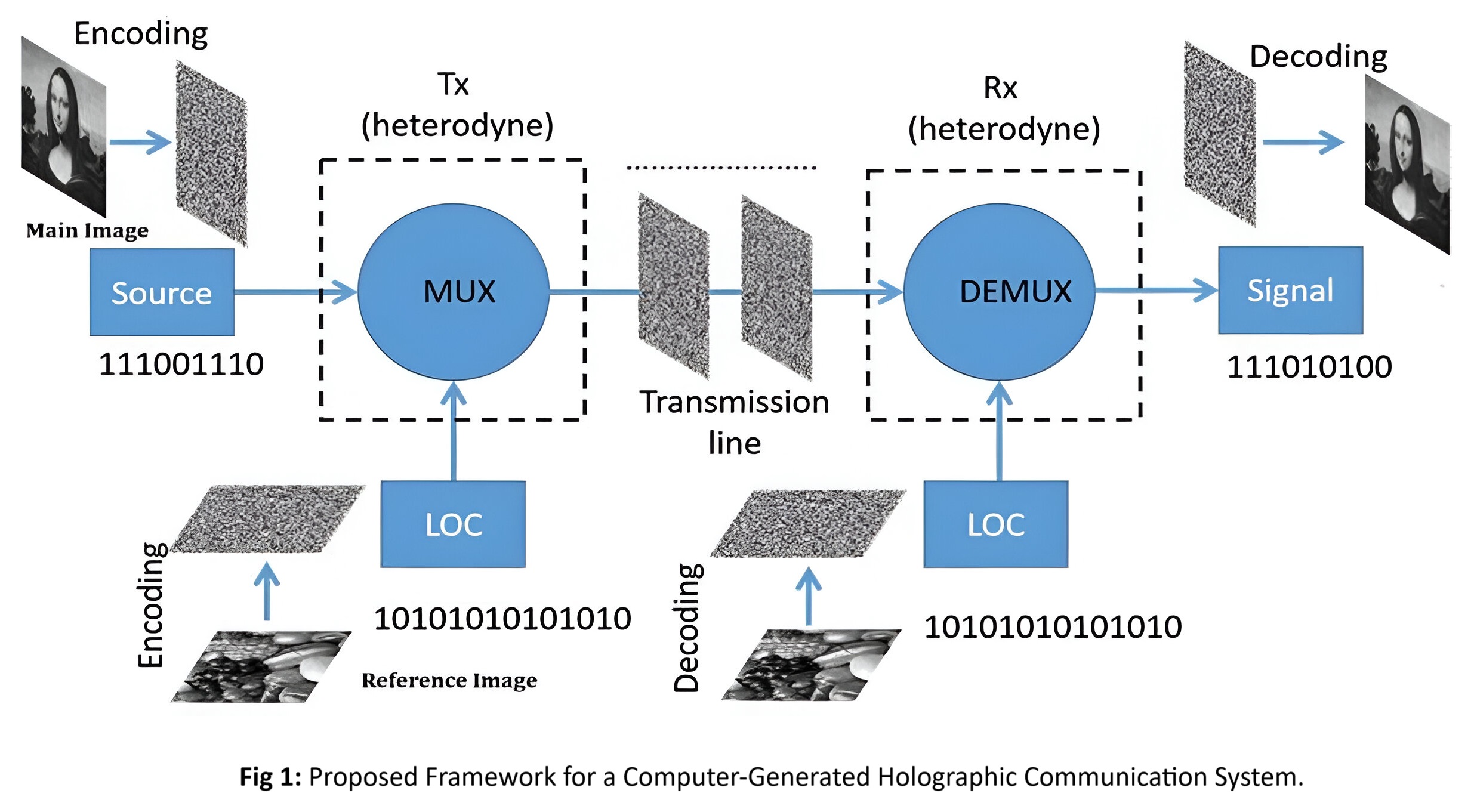
This study investigates the utilization of computer-generated holograms (CGH) in secure communication systems, employing three advanced algorithms: Fraunhofer, Gerchberg-Saxton (GS), and Fresnel. At the transmitter, digital holograms of the main and reference objects are generated and combined for transmission. At the receiver, these holograms are separated to reconstruct the main object image. The Fraunhofer algorithm generates holograms by combining far-field amplitudes but suffers from image overlapping issues, while the GS algorithm iteratively enhances phase retrieval but the procedure is not so fast. On the other hand, The Fresnel algorithm utilizes Fast Fourier Transform for hologram calculation. However, the proposed advanced Fresnel Fourier hologram method demonstrates promising results for efficient transmission and reception due to its fast processing and high-quality reconstruction with an entropy of 7.9895, redundancy of 0.0105, and RMSE of 0.84, outperforming Fraunhofer's entropy of 7.4232 and RMSE of 1.02, as well as GS’s redundancy of 0.0120 and RMSE of 0.72. This study shows the most uniform pixel distribution and lower correlation between adjacent pixels and sets the stage for the practical implementation of secure communicative CGH systems, offering enhanced security in communication through nearly impossible decoding of transmitted holograms without reference information. The study also emphasizes the significance of iterative techniques like Gerchberg-Saxton (GS) for enhancing phase retrieval accuracy in addition to addressing image overlapping issues. Furthermore, subsequent investigations could focus on real-world applications and developments in CGH technology to address changing requirements in secure communication networks.
Conclusion
This research developed a secure communication system using three algorithms: Fraunhofer diffraction, Gerchberg-Saxton (GS), and advanced Fresnel diffraction. While Fraunhofer faced limitations with twin images, the GS algorithm effectively reconstructed 3D objects. The advanced Fresnel method excelled in contrast and entropy, making it the preferred choice. An improved Fresnel-based CGH calculation program enhanced protective hologram complexity while ensuring system compatibility. Future research could explore applications in holographic storage, authentication, navigation, and interactive displays, integrating technologies such as facial recognition and fingerprint detection to drive practical advancements in holography.
References
[1]
C. Slinger, C. Cameron and M. Stanley, <em>"Computer-generated holography as a generic display technology</em>," Computer, vol. 38, no. 8, pp. 46 - 53, 08 August 2005.
[2]
Ferdous Ahmed and Md. Sultan Mahmud, "Fourier Optics and Computer Generated Hologram, <em>" International Journal of Computational Science and Engineering</em>, vol. 5, no. 1, pp. 1-7, 2015.
[3]
Gülhan Ustabaş Kaya, Ali Dursun, Zehra Saraç, "A novel reconstruction method using the Phase only information of the Computer Generated Hologram, <em>" International Conference on Advances In Computer and Electronics Technology - ACET 2013</em>, vol. 32, no. 3, pp. 17 - 20, 2013.
[4]
Edward Buckley, "Holographic Laser Projection, <em>" Journal of Display Technology</em>, vol. 7, no. 3, pp. 135-140, 2011.
[5]
Martin J. Richardson, John D. Wiltshire, Conventional Holography and Lasers, 1 ed., Wiley-IEEE Press, 2018, pp. 55 - 75.
[6]
Min Liu, Guanglin Yang, "Improved reconstruction for computer-generated hologram from digital images," Asia-Pacific Signal and Information Processing Association Annual Summit and Conference, pp. 1-4, 2013.
[7]
Alicia V. Carpentier, Humberto Michinel and José R. Salgueiro, "Making optical vortices with computer-generated holograms, <em>" American Journal of Physics</em>, vol. 76, no. 10, pp. 61-67, October 2008.
[8]
D. D. W. Olson, "The elementary plane-wave model for hologram ray tracing, <em>" American journal of physics</em>, vol. 57, no. 5, 1989.
[9]
Adam Overvig, Sajan Shrestha, Changxi Zheng and Nanfang Yu, "High-efficiency amplitude-phase modulation holograms based on dielectric metasurfaces," Conference on Lasers and Electro-Optics (CLEO), pp. 1-2, May 2017.
[10]
Liu Shou, Wang Jin-Cheng, Hsu Da-Hsiung, <em>"The art and science of anti-counterfeit embossed rainbow holograms</em>," Third International Conference on Holographic Systems, Components and Applications, pp. 210-212, 1991.
[11]
Martin J. Richardson, John D. Wiltshire, Making Conventional Denisyuk, Transmission and Reflection Holograms in the Studio, 1 ed., Wiley-IEEE Press, 2018, pp. 185-238.
[12]
A. W. Lohmann and B. R. Brown, "Complex Spatial Filtering with Binary Masks," Applied Optics, vol. 5, no. 6, p. 967, 1966.
[13]
L. B. Lesem, P. M. Hirsch, J. A. Jordan, "The Kinoform: A New Wavefront Reconstruction Device, <em>" IBM Journal of Research and Development</em>, vol. 13, no. 2, pp. 150 - 155, March 1969.
[14]
M. R. Hossain, A. Haque, O. Mojumder, F. Akter, "A Novel Implementation of Computer Generated Hologram for Highly Secured Communication Using Gerchberg-Saxton (GS) Algorithm," IEEE Region 10 Symposium (TENSYMP), pp. 1286-1289, June 2020.
[15]
Wang, Z.; Li, Y.; Tang, Z.; Li, Z.; Wang, D. Fast Hologram Calculation Method Based on Wavefront Precise Diffraction. Micromachines 2023, 14, 1690.
[16]
Su, P., Cao, W., Ma, J., Cheng, B., Liang, X., Cao, L. and Jin, G., <em>2016. Fast computer-generated hologram generation method for three-dimensional point cloud model. Journal of Display Technology</em>, 12(12), pp.1688-1694.
[17]
Pang, H., Wang, J., Cao, A., Zhang, M., Shi, L. and Deng, Q., <em>2016. Accurate hologram generation using layer-based method and iterative Fourier transform algorithm. IEEE Photonics Journal</em>, 9(1), pp.1-8.
[18]
Minikhanov, T.Z., Zlokazov, E.Y., Cheremkhin, P.A., Starikov, R.S. and Evtikhiev, N.N., <em>2023. Computer-Generated Holography Methods for Data Page Reconstruction Using Phase-Only Medium. Applied Sciences</em>, 13(7), p.4479.