Revisiting Current HR Roles to Promote "Green HRM" in the Engineering Industry Sector of Bangladesh: A Conceptual Mapping
Md. Rabiul Islam, Md. Abu Bokar Siddique
Abstract
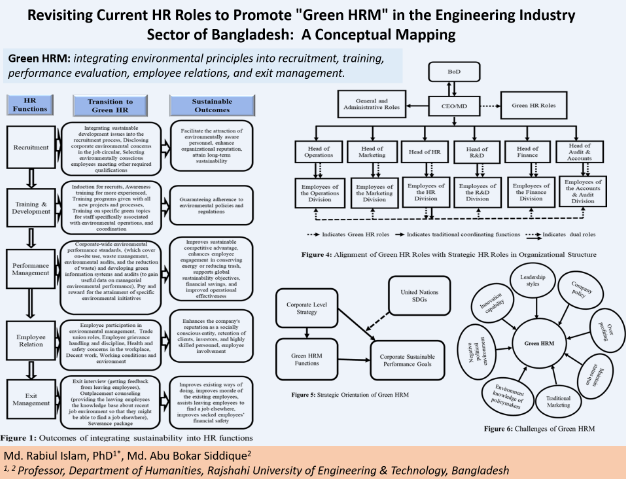
The concept of Green HRM is gaining popularity as organizations increasingly strive for sustainability. In contrast to conventional HRM, which generally emphasizes corporate objectives and operational requirements, Green HRM incorporates environmental sustainability into the framework. The key lies in integrating environmental principles into recruitment, training, performance evaluation, employee relations, and exit management. The study has reviewed the Resource-Based View and Stakeholder theories, and related scholarly publications in the domain of Green HRM to develop a conceptual mapping. Thereby it interviewed 30 persons responsible for HR functions of the Engineering Industry to identify current HR strategies and challenges associated with transition from traditional HRM to Green HRM. The results indicate that the sample industries are performing traditional HR functions although they are performing sustainable goals in isolation. Improper leadership approach, maintaining status quo, improper environment knowledge, improper innovation capability, traditional marketing and over profiting mentality are impacting implementation of Green HRM. To promote Green HRM, corporate-level strategy need to integrate Sustainable Performance Goals concerning the United Nations SDGs.
Conclusion
It is crucial to transition from traditional to Strategic Green HRM to tackle global environmental sustainability, particularly in developing countries such as Bangladesh. This study demonstrates that implementing Green HRM enables organizations to comply with legal obligations and satisfy stakeholders' expectations regarding environmental issues. By harmonizing human resources activities, such as recruiting, training, and performance management, with environmental objectives, firms can establish a staff that promotes sustainability and minimizes environmental harm. Integrating sustainability into HR processes improves business image and attracts and maintains environmentally aware personnel, increasing workforce morale and involvement. The RBV emphasizes the strategic value of human capital, and Stakeholder Theory focuses on achieving stakeholder expectations for environmental responsibility. Both theories aligned with Green HRM empower organizations to simultaneously attain commercial success and environmental objectives, augmenting their competitiveness and making valuable contributions towards global sustainability goals.
References
[1]
M. M. Uddin and Md. R. Islam, “Green HRM: Goal Attainment through Environmental Sustainability,” 2015.
[2]
D. W. S. Renwick, T. Redman, and S. Maguire, <em>“Green Human Resource Management: A Review and Research Agenda*</em>,” International Journal of Management Reviews, vol. 15, no. 1, pp. 1–14, Jan. 2013.
[3]
S. E. Jackson and J. Seo, “The greening of strategic HRM scholarship, <em>” Organisation Management Journal</em>, vol. 7, no. 4, pp. 278–290, 2010.
[4]
M. A. Delmas and M. W. Toffel, “Organizational responses to environmental demands: Opening the black box,” Oct. 2008.
[5]
M. E. Porter and M. R. Kramer, “Strategy & Society: The Link Between Competitive Advantage and Corporate Social Responsibility,” 2006. [Online]. Available: www.hbrreprints.org
[6]
C. J. C. Jabbour and A. B. L. De Sousa Jabbour, “Green Human Resource Management and Green Supply Chain Management: Linking two emerging agendas,” J Clean Prod, vol. 112, pp. 1824–1833, Jan. 2016.
[7]
R. Kramar, “Beyond strategic human resource management: Is sustainable human resource management the next approach?, <em>” International Journal of Human Resource Management</em>, vol. 25, no. 8, pp. 1069–1089, Apr. 2014.
[8]
R. Schoemaker, <em>“Green Human Resource Management: a general review.” Bachelor thesis</em>, Human Resource Studies, Tilburg University,
[9]
M. Usman and N. Mat, “Green Human Resource Management: Implication Toward Environmental Performance in Developing Countries, <em>" International Journal of Economics</em>, Management and Accounting, vol. 29, no. 1, Jun. 2021.
[10]
A. Rodríguez-Peña, “Corporate entrepreneurship and firm performance relationship under the moderating effect of environmental dynamism: Replication and extension analysis, <em>” Journal of International Entrepreneurship</em>, vol. 21, no. 4, pp. 550–585, Dec. 2023.
[11]
M. U. Shahzad, <em>“Green Human Resource Management and Its Strategic Importance In The Modern Era: A Review And Research Framework”. IJEBD</em>, vol.3, no, 4, Dec. 2020.
[12]
M. Miah, G. Szabó-Szentgróti, and V. Walter, <em>“A systematic literature review on green human resource management (GHRM): an organizational sustainability perspective</em>,” 2024, Cogent OA.
[13]
B. Wernerfelt, “A Resource-based View of the Firm, <em>” Strategic Management Journal</em>, vol. 5, 171-180, 1984.
[14]
J. Barney. Firm Resources and Sustained Competitive Advantage, vol. 17, no. 1, Mar. 1991.
[15]
D. J. Collis and C. A. Montgomery, “Competing on Resources: Strategies in the 1990s, <em>” Harvard Business Review</em>, vol. 73, no. 4, 118–128, Jun–Aug. 1995.
[16]
K. M. Eisenhardt and J. A. Martin, <em>“Dynamic Capabilities: What Are They?” Strategic Management Journal</em>, Vol. 21, No. 10/11 SPEC ISS, pp. 1105-1121, Oct. - Nov. 2000.
[17]
C. E. Helfat and M. A. Peteraf, “The dynamic resource-based view: Capability lifecycles, <em>” Strategic Management Journal</em>, vol. 24, no. 10 SPEC ISS., pp. 997–1010, Oct. 2003.
[18]
S. G. Winter, “Understanding dynamic capabilities, <em>” Strategic Management Journal</em>, vol. 24, no. 10 SPEC ISS., pp. 991–995, Oct. 2003.
[19]
R. H. Coase, “The Nature of the Firm.” Economica, New Series, Vol. 4, No. 16, pp. 386-405, Nov. 1937.
[20]
W. G. . Ouchi, Theory Z : how American business can meet the Japanese challenge. Addison-Wesley, 1987.
[21]
B. Kogut and U. Zander, “Knowledge of the firm. Combinative capabilities, <em>and the replication of technology</em>,” Knowledge in Organizations, Taylor and Francis, pp. 17–36, 2009.
[22]
R. M. Grant, “Toward a knowledge-based theory of the firm, <em>” Strategic Management Journal</em>, vol. 17, no. SUPPL. WINTER, pp. 109–122, 1996.
[23]
C. Sathya, J. Jayakrishnan, and R. Manivannan, <em>“Green HRM Practices –A Review of Literature” International Journal of Research and Analytical Reviews</em>, vol. 5, no. 4, pp 284-286, Oct.-Dec. 2018.
[24]
A. Mohammad Ashraful, X. Niu, and N. Rounok, “Effect of green human resource management (GHRM) overall on organization’s environmental performance, <em>” International Journal of Research in Business and Social Science (2147- 4478)</em>, vol. 10, no. 4, pp. 99–116, Jun. 2021.
[25]
P. Trivellas, A. Rafailidis, P. Polychroniou, and P. Dekoulou, “Corporate social responsibility (CSR) and its internal consequences on job performance: The influence of corporate ethical values, <em>” International Journal of Quality and Service Sciences</em>, vol. 11, no. 2, pp. 265–282, Jun. 2019.
[26]
J. Dumont, J. Shen, and X. Deng, “Effects of Green HRM Practices on Employee Workplace Green Behavior: The Role of Psychological Green Climate and Employee Green Values,” Hum Resour Manage, vol. 56, no. 4, pp. 613–627, Jul. 2017.
[27]
S. Ren, F. L. Cooke, G. K. Stahl, D. Fan, and A. R. Timming, <em>“Advancing the sustainability agenda through strategic human resource management: Insights and suggestions for future research</em>,” Hum Resour Manage, vol. 62, no. 3, pp. 251–265, May 2023.
[28]
R. Hameed, N. Rehman, S. Tufail, and M. Kiziloglu, “Green human resource management and environmental knowledge: A moderated mediation model to endorse green CSR,” Front Environ Sci, vol. 11, 2023.
[29]
C. R. Carter and D. S. Rogers, “A framework of sustainable supply chain management: Moving toward new theory,” 2008.
[30]
R. E. E. Freeman and J. McVea, “A Stakeholder Approach to Strategic Management, <em>” SSRN Electronic Journal</em>, Jul. 2005.
[31]
M. E. Porter and M. R. Kramer, “The Big idea Creating Shared Value how to reinvent capitalism-and unleash a wave of innovation and growth, <em>” Harvard Business Review</em>, vol. 89, no. 1-2, pp.62-77, Jan.-Feb. 2011. HBR.ORG.
[32]
J. Elkington, “Partnerships from cannibals with forks: The triple bottom line of 21st-century business,” Environmental Quality Management, vol. 8, no. 1, pp. 37–51, 1998.
[33]
A. B. Carroll, “The pyramid of corporate social responsibility: Toward the moral management of organizational stakeholders,” Bus Horiz, vol. 34, no. 4, pp. 39–48, 1991.
[34]
T. Donaldson and L. E. Preston, “The Stakeholder Theory of the Corporation: Concepts, Evidence, <em>and Implications" The Academy of Management Review</em>, vol. 20, no. 1, pp. 65-91, Jan. 1995.
[35]
L. Author and S. A. Waddock, “The Corporate Social Performance-Financial Performance, <em>” Strategic Management Journal</em>, vol. 18, no. 4, pp. 303-319, 1997.
[36]
M. Friedman, “The Social Responsibility of Business Is to Increase Its Profits,” The New Work Times, Sept. 13, 1970.
[37]
M. C. Jensen and W. H. Meckling, “Theory of the firm: Managerial behavior, agency costs and ownership structure, <em>" Journal of Financial Economics</em>, vol. 3, no. 4, pp. 305-360, Oct. 1976,
[38]
M. Z. Iqbal, S. Akbar, and P. Budhwar, “Effectiveness of Performance Appraisal: An Integrated Framework, <em>” International Journal of Management Reviews</em>, vol. 17, no. 4, pp. 510–533, Oct. 2015.
[39]
R. Hameed, N. Rehman, S. Tufail, and M. Kiziloglu, “Green human resource management and environmental knowledge: A moderated mediation model to endorse green CSR,” Front Environ Sci, vol. 11, 2023.
[40]
N. K. H. Tran, “Customer pressure and creating green innovation: The role of green thinking and green creativity,” Sustainable Futures, vol. 7, Jun. 2024.
[41]
A. B. Carroll, “Corporate social responsibility: The centerpiece of competing and complementary frameworks,” Organ Dyn, vol. 44, no. 2, pp. 87–96, Apr. 2015.
[42]
M. Chapol Ali, K. M. Anwarul Islam, S.-J. Chung, N. M. Zayed, and M. Afrin, “A study of Green Human Resources Management and Green Creativity for Human Resources Professionals, <em>” International Journal of Business and Management Future</em>, vol. 4, no. 2, 2020.
[43]
C. A. Ramus and U. Steger, “The Roles of Supervisory Support Behaviors and Environmental Policy in Employee 'Eco incentives' at Leading-edge European Companies, <em>” Academy of Management Journal</em>, vol. 43, no. 4, pp. 605-626, Aug. 2000.
[44]
C. J. C. Jabbour and F. C. A. Santos, “The central role of human resource management in the search for sustainable organizations, <em>” International Journal of Human Resource Management</em>, vol. 19, no. 12, pp. 2133–2154, 2008.
[45]
A. P. Hejnowicz and M. A. Rudd, <em>“The value landscape in ecosystem services: Value</em>, value wherefore art thou value?” Sustainability, vol.9, no. 5, May 19, 2017, MDPI.
[46]
S. Kang and W. M. Hur, “Investigating the Antecedents of Green Brand Equity: A Sustainable Development Perspective,” Corp Soc Responsib Environ Manag, vol. 19, no. 5, pp. 306–316, Sep. 2012.
[47]
S. Ahmad, “Green Human Resource Management: Policies and practices,” Dec. 31, 2015, Cogent OA.
[48]
P. J. Dimaggio and W. W. Powell, “The Iron Cage Revisited: Institutional Isomorphism and Collective Rationality in Organizational Fields, <em>” American Sociological Review</em>, vol. 48, no. 2, pp. 147-160, Apr. 1983.
[49]
O. E. Williamson, “The Economics of Organization: The Transaction Cost Approach’.” [Online]. Available: http://www.journals.uchicago.edu/t-and-c
[50]
M. T. Hannan and J. Freeman, “The Population Ecology of Organizations,” AJS, vo. l87, no. 3, pp. 548-577, 1981.
[51]
S. Ren, G. Tang, and S. E. Jackson, <em>“Green human resource management research in emergence: A review and future directions</em>,” Asia Pacific Journal of Management, vol. 35, no. 3, pp. 769–803, Sep. 2018.