Security in Correlated Cognitive Radio Channels with Interference
T. Kumar, M. Z. I. Sarkar, D. K. Sarker
Abstract
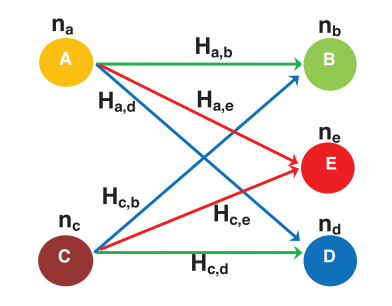
Cognitive radio network is capable of adopting the best wireless channels by dynamic spectrum management avoiding user interference and congestion. In this paper, secure wireless communication scenario is considered through a multiple-input multiple-output (MIMO) cognitive interference radio network over Rayleigh fading channel. It consists of a primary user A, a secondary user C, a primary receiver B, a secondary receiver D and an eavesdropper E. When A communicates with B, it interferes D, and E tries to decode information from A. In a similar manner, when C communicates with D, it interferes B, and E tries to decode information from C. It is assumed that the terminals of users, receivers and eavesdropper all are equipped with correlated multiple antennas. On the basis of these considerations, we derive the closed-form analytical expression of the ergodic secrecy capacity at the receivers with antenna correlations of all terminals. The effects of transmitting and receiving antennas, their correlations and diversities on the ergodic secrecy capacity are investigated in the presence of eavesdropper. In addition, the effect of antenna correlation with interference case is compared with the case of without interference. Moreover, the effects of eavesdropper antennas and their correlations on the ergodic secrecy capacity are also investigated.
Conclusion
The Key contribution of this paper is to derive the closed-form analytical expression for the ergodic secrecy capacity at the receivers of a MIMO cognitive interference radio network considering antenna correlations at the terminals of cognitive radio networks. Based on our observations and from the numerical results, it can be concluded that although, ergodic secrecy capacity of a MIMO channels can be appreciably enhanced by increasing the number of transmitting/receiving antennas, but spatial correlation effect of antennas significantly reduces the ergodic secrecy capacity of a MIMO cognitive interference radio network. As the effect correlation is reduced in the presence of interference, so a MIMO network system (which suffers from correlation effect) will be suitable for interference channel scenarios. Moreover, a tradeoff between the number of transmitting/receiving antennas and correlation is necessary for achieving better performance from a MIMO cognitive interference radio network.
References
[1]
M. Elkashlan, L. Wang, T. Q. Duong, G. K. Karagiannidis, A. Nallanathan, “On the security of cognitive radio networks”, <em>Transactions on Vehicular Technology</em>, IEEE, Vol.64, No.8, pp.3790 – 3795, 2015.
[2]
Z. Shu, Y. Yang, Y. Qian, R. Q. Hu, “Impact of interference on secrecy capacity in a cognitive radio network”, in Proc. IEEE Global Telecommunications Conference (GLOBECOM 2011), 2011, pp.1–6.
[3]
J. Zhu, “Security-reliability trade-off for cognitive radio networks in the presence of eavesdropping attack”, <em>Journal on Ad- vances in Signal Processing</em>, EURASIP, Vol.1, pp.169, 2013.
[4]
V. Nguyen, T. M. Hoang, O. Shin, <em>“Secrecy capacity of the primary system in a cognitive radio network”</em>, Transactions on Vehicular Technology, IEEE, Vol.64, No.8, pp.3834 – 3843, 2015.
[5]
W. Liu, M. Z. I. Sarkar, T. Ratnarajah, H. Du, “Securing cognitive radio with a combined approach of beamforming and cooperative jamming”, Communications, IET, Vol.11, No.1, pp.1–9, 2017.
[6]
B. Li, X. Qi, K. Huang, Z. Fei, F. Zhou, and R.Q. Hu, “Security-reliability Tradeoff analysis for cooperative NOMA in cognitive radio networksˇT, Transactions on Communications, IEEE, Vol.67, No.1, pp.83–96, 2019.
[7]
X. Ding , Y. Zou , G. Zhang , X. Chen, X.Wang, and L. Hanzo, “The securityU˝ reliability tradeoff of multiuser scheduling-aided energy harvesting cognitive radio networksˇT, Transactions on Communications, IEEE, Vol.67, No.6, pp.3890–3904, 2019.
[8]
Y. Song, W. Yang, X. Yang, Z. Xiang, and B. Wang, “Physical layer security in cognitive millimeter wave networksˇT, IEEE Access, IEEE, Vol.7, pp.109162–109180, 2019.
[9]
M. Bouabdellah, F. E. Bouanani, P. C. Sofotasios, S. Muhaidat, D. Benevides D. Costa , K. Mezher, H. Ben-Azza, and G. K. Karagiannidis, “Cooperative energy harvesting cognitive radio networks with spectrum sharing and security constraintsˇT, IEEE Access, IEEE, Vol.7, pp.173329–173343, 2019.
[10]
M. Chiani, M. Z. Win, A. Zanella, “On the capacity of spatially correlated MIMO Rayleigh-fading channels”, Transactions on Information Theory, IEEE, Vol.49, No.10, pp.2363–2371, 2003.
[11]
H. Shin, M. Z. Win, J. H. Lee, M. Chiani, “On the capacity of doubly correlated MIMO channels”, Transactions on Wireless Communications, IEEE, Vol.5, No.8, pp.2253–2265, 2006.
[12]
D. A. Basnayaka, H. Haas, “MIMO interference channel between spatial multiplexing and spatial modulation”, Transactions on Communications, IEEE, Vol.64, No.8, pp.3369–3381, 2016.
[13]
Y. Wang, D.-W. Yue, “Capacity of MIMO Rayleigh fading channels in the presence of interference and receive correlation”, <em>Transactions on Vehicular Technology</em>, IEEE, Vol.58, No.8, pp.4398 – 4405, 2009.
[14]
X. Sun, J.Wang,W. Xu, C. Zhao, “Performance of secure communications over correlated fading channels”, Signal Processing Letters, IEEE, Vol.19, No.8, pp.479–482, 2012.
[15]
G. Nauryzbayev, E. Alsusa, M. Abdallah, “On the feasibility of interference alignment in compounded MIMO broadcast channels with antenna correlation and mixed user classes”, <em>Transactions on Vehicular Technology</em>, IEEE, Vol.67, No.3, pp.2130 – 2140, 2018.
[16]
K. H.Van, T. D. Dac, “Impact of primary interference on secrecy performance of physical layer security in cognitive radio networks”, Wireless Personal Communications, Springer, pp.1099–1127, 2018.
[17]
M. S. A. D. K. Sarker, M. Z. I. Sarkar, “Secure wireless multicasting with linear equalization”, Physical Communication, Elsevier, Vol.25, No.1, pp.201–2013, 2017.
[18]
H. Shin, “Capacity and error exponents for multiple-input multipleo-utput wireless channels”, Ph.D. thesis, Seoul National University, Seoul, Korea, 2004.