Trajectory Routing of an Autonomous Aerial Vehicle with Parabolic Blending Method and BFS Algorithm
Md. Nur a Shams, Md. Asaduzzaman Abrar, Md. Manirul Islam, M. R. I. Sheikh
Abstract
Unmanned Aerial Vehicle (UAV) has experienced enormous development over the past few years. However, UAV's path planning problem is still deemed critical in developing autonomous trajectory planning. For instance, the traditional node to node linear transitions in trajectory planning can cause a loss in dynamic behavior like velocity and acceleration. Blend in trajectory such as parabolic type can preserve dynamics with smoother transitions in a node connecting two linear paths. This paper presents the Breadth First Search (BFS) algorithm for routing setpoints (nodes) with a parabolic blend in trajectory between two linear path segments in each node for smooth steering with more excellent manoeuvrability. Specially, a decision-support tool is developed to guide UAVs in configuring a multi-rotor vehicle support autonomous routing capability and trajectory blending. The project also reports communication be implemented via PubNub, an online broker to update necessary geo-locations from remote systems. Finally, the solution for path planning in the UAV was tested in a real simulation scenario.
Conclusion
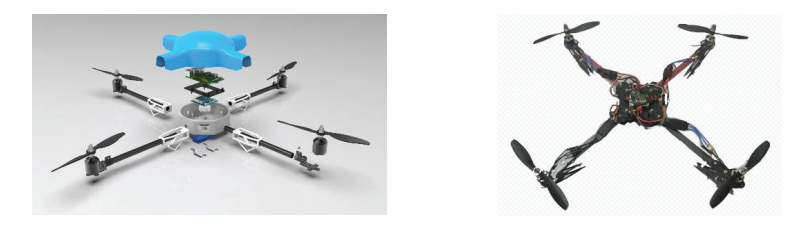
The goal of the project was to develop an autonomous quad copter and its autonomous routing along with blended trajectory. New technologies have implemented on the field for different application purposes. Transforming straight trajectory into a blended trajectory with parabolic nature has introduced necessary smoothness in steering ability for such kind of systems. By using the blended trajectory, the velocity and acceleration, thus the dynamic behaviours of the system can be constrained without losing any agility. Necessary longitudes, latitudes coordinates were mapped. Besides, the altitude of the UAV was remained constrained in whole process. This technique made the navigation system of the quadcopter unchanged and consistent. The BFS algorithm was acted as a supportive implementation tool to attain trajectory generation and necessary testing data. By using the autonomous aircraft system, it can reduce the need of labours. With the help of GPS system, a payload can be delivered anywhere autonomously. Using android application, it will help to get the feedback from the aircraft to find the latitude, longitude and altitude of the UAV which can reduce the system error in run time. As a result, the navigation system of the quad copter will be smoother and more consistent while flying in the trajectory.
References
[1]
Chao, HaiYang, YongCan Cao, <em>and YangQuan Chen. "Autopilots for small unmanned aerial vehicles: a survey." International Journal of Control</em>, Automation and Systems 8.1 (2010): 36-44.
[2]
M. Achtelika, A. Bachrach, R. He, S. Prentice, and N. Roy, “Autonomous navigation and exploration of a quadrotor helicopter in gpsdenied indoor environments,” First Symposium on Indoor Flight, 2009.
[3]
Hussein, Ahmed & Al-Kaff, Abdulla & de la Escalera, Arturo & Armingol, J.M., “Autonomous Indoor Navigation of Low-Cost Quadcopters”, International Conference on Service Operations and Logistics, and Informatics, IEEE, 2015. Doi
https://doi.org/10.1109/SOLI.2015.7367607
[4]
Ali, Ashruf, Nathan Ballou, Brad McDougall,” Decision Sopport Tool for Designing Small Package Delivery Aerial Vehicles (DST-SPADAV), <em>“system and information engineering design in symposium (SIEDS)</em>,2015. IEEE 2015.
[5]
S. Sukkarieh, E. M. Nebot, and H. F. Durrant-Whyte, “A high integrity imu/gps navigation loop for autonomous landvehicle applications,” Transactions on Robotics and Automation, IEEE., vol. 15, no. 3, pp. 572–578, 1999.
[6]
Marius Beul, Sebastian Houben, Matthias Nieuwenhuisen, Sven Behnke, "Fast autonomous landing on a moving target at MBZIRC", Mobile Robots (ECMR) 2017 European Conference on, pp. 1-6, 2017
[7]
Leong, Bernard Tat Meng, Sew Ming Low, and Melanie Po-Leen Ooi. "Low-cost microcontroller-based hover control design of a quadcopter." Procedia Engineering 41 (2012): 458-464.
[8]
Yayan rima Nugraha, Dwi Hanto, Andi Setiono, Tomi Waluyo, Bambang Widiyatmoko, "Design of instrumentation for flatness measurement of railroads", <em>Automation Cognitive Science Optics Micro ElectroMechanical System and Information Technology (ICACOMIT) 2015 International Conference on</em>, pp. 160-163, 2015.
[9]
Nagarjuna, Kotha, and G. R. Suresh. "Design of effective landing mechanism for fully autonomous Unmanned Aerial Vehicle" Signal Processing, Communication and Networking (ICSCN), 2015 3rd International Conference on. IEEE, 2015.
[10]
T. Zhang, Y. Kang, M. Achtelik, K. Kuhnlenz, and M. Buss, “Autonomous hovering of a vision/imu guided quadrotor,” International Conference on Mechatronics and Automation (ICMA). IEEE., pp.2870–2875,2009
[11]
Chimpalthradi R. Ashokkumar, George W.P. York, Ernie Lagimoniere, "Time response bounds in nonlinear UAV control", <em>International Conference on Unmanned Aircraft Systems (ICUAS) 2017</em>, pp. 16-22, 2017.
[12]
Matthias Nieuwenhuisen, Marius Beul, Radu Alexandru Rosu, Jan Quenzel, Dmytro Pavlichenko, Sebastian Houben, Sven Behnke, "Collaborative object picking and delivery with a team of micro aerial vehicles at MBZIRC",MobileRobots (ECMR) 2017 European Conference on, pp. 1-6, 2017.
[13]
https://bdspeedytech.com/
[14]
https://www.techshopbd.com/product-categories/intertial/2817/barometric-pressure-sensor-bmp180-techshop-bangladesh.
[15]
https://www.techshopbd.com/product-categories/module/3028/gps-module-gy-neo-6m-v2-techshop-bangladesh.
[16]
R. Dube, A. Gawel, C. Cadena, R. Siegwart, L. Freda, and M.´Gianni, “3D localization, mapping and path planning for search and rescue operations, <em>” in Proceedings of the 14th International Symposium on Safety</em>, Security and Rescue Robotics, SSRR2016, pp. 272-273, Switzerland, October 2016.
[17]
M. Jun and R. D’Andrea, “Path Planning for Unmanned Aerial Vehicles in Uncertain and Adversarial Environments,” in Cooperative Control: Models, Applications and Algorithms, <em>vol.1 of Cooperative Systems</em>, pp. 95–110, Springer US, Boston, MA, 2003.
[18]
F. Kamrani and R. Ayani, UAV path planning in search operations, Aerial Vehicles, InTech, 2009.
[19]
C. Baker, G. Ramchurn, L. Teacy, and N. Jennings, “Planning search and rescue missions for UAV teams, <em>” in Proceedings of the in 2016: Conference on Prestigious Applications of Intelligent Systems at ECAI</em>, 2016, p. 6, 2016.