Performance Investigation of Robust Antenna Array Processor for minimizing Mutual Coupling Effect and Steering Angle Disparity
M. F. Ali, M. S. Hossain, M. F. Reza, M. M. Rashid
Abstract
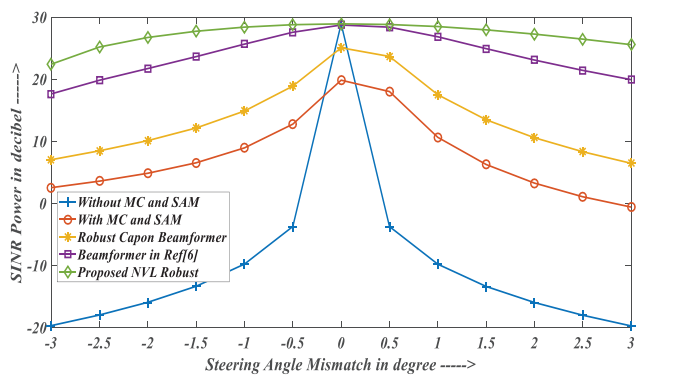
Antenna array processor’s performance is limited extremely in the existence of two array imperfections; mutual coupling (MC) among antenna array elements and steering angle disparity (SAD). That's why; robustness for antenna array processor has come to be a vital issue. The key shortcomings of conventional robust loading techniques are that there is no such algorithm to minimize both MC effect and SAD acting at the same time and no perfect perception is concerned to choose the level of loading according to error level. The proposed robust loading technique maximally minimizes the MC effect and SAD acting alone or in accompany. It is also able to cancel interference from signal of interests and to select loading levels spontaneously according to error level that makes it as a completely automatic loading method. The performance of the presented loading technique is evaluated in the existence of MC effect as well as SAD through numerical examples and fitness among existing robust array processors have also been compared. This paper also shows that the demonstrated method performs superior than the existing conventional method.
Conclusion
In this paper we have shown the superiority of proposed NVL robust MVDR antenna array processor against mutual coupling effect and steering angle disparity. It can minimize both of these effects in a same algorithm and doesn’t need any fixed loading level rather it is a completely automatic loading technique. A number of MATLAB simulations explain the excellent performance of this proposed algorithm. Examples have been presented to compare the performance of NVL with the existing GLC and FDL techniques. It has been shown using computer simulation that the proposed robust processor achieved 6dB higher SINR than the existing processor [6]. We have demonstrated that NVL is very useful in the case where the users of adaptive arrays are most interested for higher gain and better performance.
References
[1]
M. S. Hossain, G. N. Milford, M. C. Reed and L. C. Godara, “Efficient Robust Broadband Antenna Array Processor in the Presence of Look Direction Errors”, IEEE Transactions on Antennas and Propagation, Vol. 61, No. 2, pp. 718-727, Feb. 2013.
[2]
J. Li, P. Stoica, and Z. Wang, “On Robust Capon Beamforming and Diagonal Loading”, IEEE Transactions on Signal Processing, Vol. 51, No. 7, July 2003.
[3]
M. F. Ali and M. S. Hossain, “Robust Beamformer in the Presence of Mutual Coupling”, <em>International Journal of Engineering Technology</em>, Management and Applied Sciences, Vol. 3, No, 4, ISSN 2349-4476.April 2015.
[4]
C. A. Balanis, “Antenna Theory: Analysis and design”, John Willy and Sons, 3rd Edition, USA, 2005.
[5]
L. C. Godara, “Smart Antenna”, CRC press, 2004.
[6]
M. F. Ali, M. S. Hossain and M. M. Rashid, “Robust Antenna Array Processor in the Presence of Steering Angle Mismatch and Mutual Coupling Effect”, The first IEEE International Conference on Telecommunications & Photonics, 26-28 Dec, 2015, Bangladesh.
[7]
R. Goossens and H. Rogier, “MVDR beam forming in the presence of mutual coupling”, <em>International Conference on Communications and Vehicular Technology</em>, 23-23 Nov. 2006.
[8]
P. Stoica, Z. Wang and J. Li, “Robust Capon Beamforming”, IEEE Signal Processing Letters, Vol. 10, No. 6, June 2003.
[9]
L. Du, J. Li and P. Stoica, “Fully Automatic Computation of Diagonal Loading Levels for Robust Adaptive Beamforming”, <em>IEEE Transactions on Aerospace and Electronic Systems</em>, Vol. 46, No. 1 January 2010.
[10]
L. Hongqing, L. Guisheng and Z. Jie, “A robust adaptive Capon beamforming”, Elsevier, Signal Processing 86 (2006) 2820–2826
[11]
H. T. Hui, “Compensating for the Mutual Coupling Effect in Direction Finding Based on a New Calculation Method for Mutual Impedance”, IEEE Antennas and Wireless Propagation Letters, Vol. 2, 2003.
[12]
Q. Yuan, Q. Chenn and K. Sawaya, “Performance of Adaptive Array Antenna with Arbitrary Geometry in the Presence of Mutual Coupling”, IEEE Transactions on Antennas and Propagation, Vol. 54, No. 7, July 2006.
[13]
P. Demarcke, H. Rogier, R. Goossens, and P. D. Jaeger, “Beamforming in the Presence of Mutual Coupling Based on Constrained Particle Swarm Optimization”, IEEE Transactions on Antennas and Propagation, Vol. 57, No. 6, June 2009.
[14]
J. Yang, X. Ma, C. Hou and Y. Liu, “Automatic Generalized Loading for Robust Adaptive Beamforming”, IEEE Signal Processing Letters, Vol. 16, No. 3, March 2009.
[15]
O. Besson and F. Vincent, “Performance Analysis of Beamformers Using Generalized Loading of the Covariance Matrix in the Presence of Random Steering Vector Errors”, IEEE Transactions on Signal Processing, Vol. 53, No. 2, February 2005.
[16]
M. S. Hossain, G. N. Milford, M. C. Reed and L. C. Godara, “Robust Efficient Broadband Antenna Array Pattern Synthesis Techniques”, IEEE Transactions on Antennas and Propagation, Vol. 62, No. 9, pp. 4537-4545, Sep. 2014.
[17]
P. Shankpa, V. V. Arur , G. R. Kadambi and J. Shuttleworth, “A Novel Approach for Near Field Beamforming”, <em>International Journal on Communications Antenna and Propagation</em>, pp. 64-76 Vol. 4, No. 3, 2014.
[18]
H. M. Elkamchouchi, D. A. E. Mohamed, O. G. Mohamed and W. A. E. Ali, <em>“Multiuser Detection Using Blind Robust Beamforming in Multipath Environment for LTE System”</em>, International Journal on Communications Antenna and Propagation, pp.291-298, Vol. 6, No. 5, 2016.
[19]
N. Parhizgar, “A new mutual coupling compensation method for receiving antenna array-based DOA estimation”, <em>Polish Academy of Sciences Journals</em>, pp. 419–431, Vol. 67(2), 2018.
[20]
Y. Hao, N. Zou, and G. Liang, “Robust Capon Beamforming against Steering Vector Error Dominated by Large Direction-of-Arrival Mismatch for Passive Sonar”, <em>Journal of Marine Science and Engineering</em>, Vol. 80(7), 2019.