Assessment of Noise Levels in a Construction Site: A Case Study
Md. Shadman Rafid, Shahajada Mahmudul Hasan, Md. Naeem-Ur-Rahman
Abstract
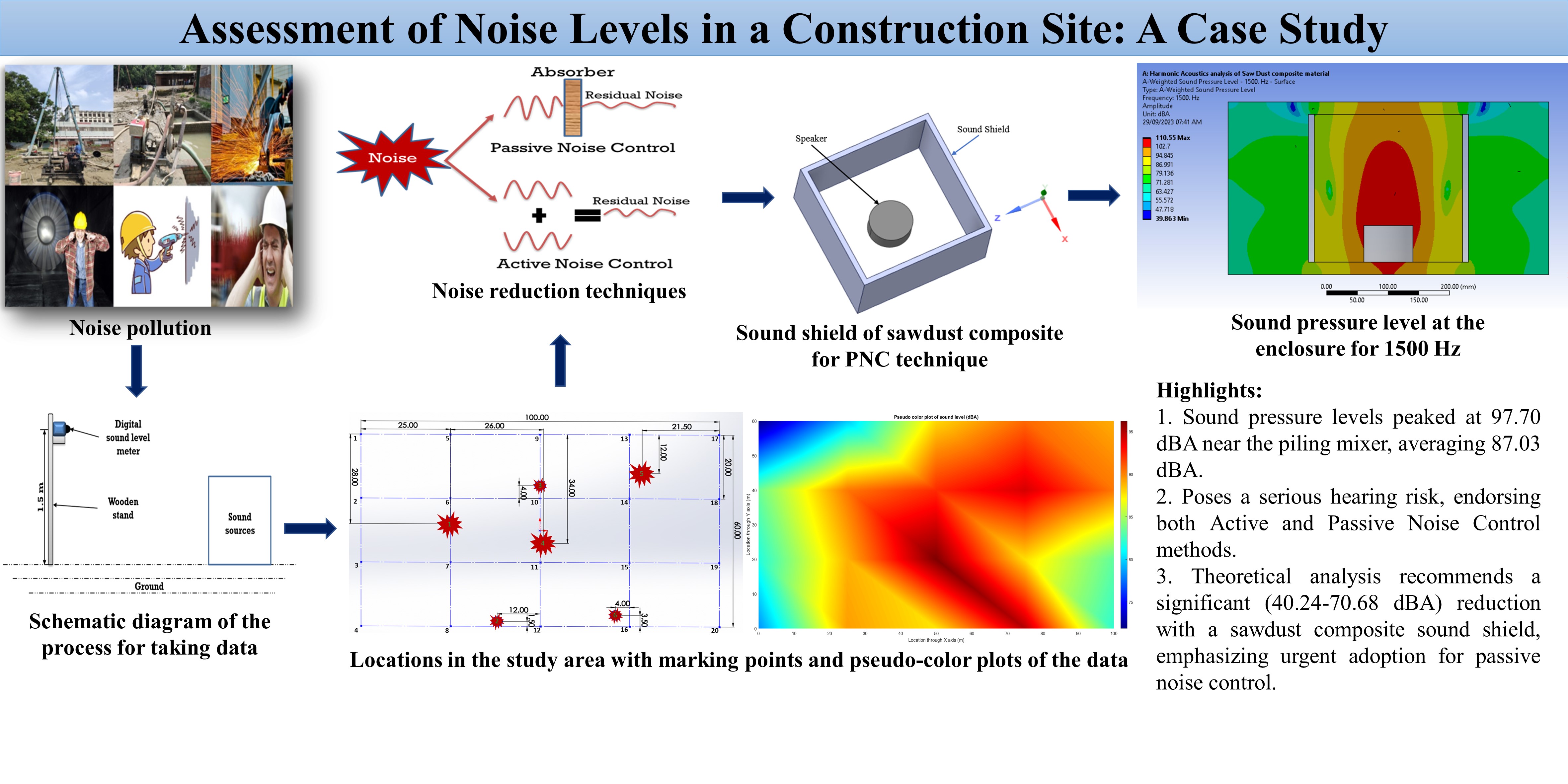
A study was conducted at a construction site to assess noise levels at various locations during operational hours. Using a digital sound level meter, the maximum sound level was measured near the piling mixer, contrasting with the minimum intensity recorded away from any sound source. The overall average sound level was 87.03 dBA. This high noise level poses a risk of serious hearing impairment. To mitigate this issue, Active Noise Control (ANC) and Passive Noise Control (PNC) methods can be employed. The theoretical analysis of the sawdust composite sound shield reveals a promising reduction, ranging from 40.24 dBA to 70.68 dBA, ensuring compliance with standard sound levels in various areas. The research strongly recommends the adoption of passive noise control, specifically through the use of natural composites. It emphasizes the urgent implementation of measures to protect the health of construction workers and surrounding residents by covering noise sources.
Conclusion
The primary focus of this study is to assess noise levels at construction sites and understand their impact on workers' and residents' health, while also exploring effective strategies for sound pollution management. The findings underscore the urgent need for sound pollution control measures, especially in industrial and construction sites where noise pollution is often neglected. With an average recorded noise level of 87.03 dBA, the study highlights the severity of the issue and potential health risks for workers such as serious hearing loss. Despite being a substantial environmental concern, noise pollution often receives less attention than other forms. This study emphasizes the importance of prioritizing noise reduction efforts and exploring strategies to create quieter and healthier environments for those exposed to construction-related noise. The research identifies the effectiveness of natural composite sound shields, particularly those incorporating sawdust, as a promising approach to addressing sound pollution and enhancing living and working conditions. The composite sound shield achieves a maximum reduction of 70.68 dBA at 1500 Hz and a minimum reduction of 40.24 dBA at 1200 Hz, ensuring sound levels below standard thresholds in diverse areas. The innovative use of readily available materials emerges as a pivotal factor in mitigating noise pollution and contributing to an improved overall quality of life for workers and the broader community.
In response to these challenges, several recommendations are proposed. Firstly, the adoption of the ANC method can be a viable solution. Additionally, the PNC method is suggested as an effective choice. Combining both ANC and PNC methods is advocated to achieve a comprehensive approach to pollution reduction.
References
[1]
A. K. Sahu, S. K. Nayak, C. R. Mohanty, and P. K. Pradhan, “Traffic noise and its impact on wellness of the residents in sambalpur city–a critical analysis,” Archives of Acoustics, vol. 46, no. 2, pp. 353–363, 2021.
[2]
M. M. Richter, S. Paul, V. Këpuska, and M. Silaghi, “Noisy Signals,” in Signal Processing and Machine Learning with Applications, Springer, 2022, pp. 307–326.
[3]
B. Berglund, T. Lindvall, and others, “Community noise,” 1995.
[4]
A. Gupta, A. Gupta, K. Jain, and S. Gupta, “Noise pollution and impact on children health, <em>” The Indian Journal of Pediatrics</em>, vol. 85, no. 4, pp. 300–306, 2018.
[5]
R. C. BANTAI, “REGULATION OF LIBRARY NOISE POLICY FOR EFFECTIVE NOISE CONTROL,” Regulation, vol. 3, no. 1, 2021.
[6]
S. Alam, S. T. Akter, M. S. Sheikh, I. Bahar, and others, “The impact of noise pollution on workers’ health in selected industries of Mirzapur industrial area, Tangail, Bangladesh., <em>” Journal of Environmental Science and Natural Resources</em>, vol. 9, no. 2, pp. 155–160, 2016.
[7]
M. J. Owoyemi, B. Falemara, and A. J. Owoyemi, “Noise pollution and control in wood mechanical processing wood industries,” 2016.
[8]
S. P. Gongi, J. Kaluyi, and C. L. Kanali, “Industrial Noise Pollution and its Health Effects on Wokers in Nairoby City, <em>” International Journal of Engineering and research and Technology</em>, vol. 181, no. 5, pp. 426–435, 2016.
[9]
A. H. CHOWDHURY, M. D. M. HOQUE, and M. D. BODRUD-DOZA, “NOISE POLLUTION MONITORING AT DIFFERENT PLACES IN TANGAIL MUNICIPAL AREA, BANGLADESH, <em>” Journal of Science and Technology</em>, vol. 4, no. 1, pp. 91–99, 2014.
[10]
M. H. Noweir, A. O. Bafail, and I. M. Jomoah, “Noise pollution in metalwork and woodwork industries in the Kingdom of Saudi Arabia, <em>” International Journal of Occupational Safety and Ergonomics</em>, vol. 20, no. 4, pp. 661–670, 2014.
[11]
S. Salehin, K. M. Nazmul Islam, M. S. Alam, and M. M. Hossain, “Industrial noise levels in Bangladesh; is worker health at risk?,” Pol J Environ Stud, vol. 23, no. 5, 2014.
[12]
O. Stephen, D.-V. Abraham, and A.-O. Richard, “The silent killer: an assessment of level of industrial noise and associated health effects on workers, <em>” International journal of basic and applied sciences</em>, vol. 2, no. 2, p. 165, 2013.
[13]
A. A. Abbasi, H. B. Marri, and M. Nebhwani, “Industrial noise pollution and its impacts on workers in the textile based cottage industries: an empirical study, <em>” Mehran University Research Journal of Engineering & Technology</em>, vol. 30, no. 1, pp. 16–35, 2011.
[14]
O. S. Oyedepo and A. A. Saadu, “A comparative study of noise pollution levels in some selected areas in Ilorin Metropolis, Nigeria,” Environ Monit Assess, vol. 158, pp. 155–167, 2009.
[15]
C. A. Boateng and G. K. Amedofu, “Industrial noise pollution and its effects on the hearing capabilities of workers: A study from saw mills, printing presses and corn mills,” Afr J Health Sci, vol. 11, no. 1, pp. 55–60, 2004.
[16]
A. O. Akpan, M. U. Onuu, A. I. Menkiti, and U. E. Asuquo, “Measurement and Analysis of Industrial Noise and its Impact on workers in Akwa Ibom State, South Eastern Nigerian, <em>” Nigerian journal of Physics</em>, vol. 15, no. 2, pp. 41–45, 2003.
[17]
C. Agbo, P. Akpan, P. Onyechi, and P. Ozor, “A Natural Convective Passive Noise Control System for Mini-Generators”.
[18]
D. Pardo-Quiles, J.-V. Rodr\’\iguez, J.-M. Molina-Garc\’\ia-Pardo, and L. Juan-Llácer, “Traffic noise mitigation using single and double barrier caps of different shapes for an extended frequency range, <em>” Applied Sciences</em>, vol. 10, no. 17, p. 5746, 2020, doi
https://doi.org/10.3390/app10175746
[19]
E. Gieva, I. Ruskova, K. Nedelchev, and I. Kralov, “An investigation of the influence of the geometrical parameters of a passive traffic noise barrier upon the noise reduction response, <em>” in AIP Conference Proceedings</em>, 2018, p. 20020. doi
https://doi.org/10.1063/1.5082038
[20]
D. Liu, Z. Chen, Y. Ji, H. Li, X. Tuo, and W. Zheng, <em>“Design and Experimental Research on Natural Ventilation Windows Based on Active and Passive Noise Reduction Technologies</em>,” in 5th International Conference on Civil Engineering and Transportation, 2015, pp. 1780–1785. doi
https://doi.org/10.2991/iccet-15.2015.331
[21]
M. R. Monazzam-Esmaeelpour, Z. Hashemi, R. Golmohammadi, and N. Zaredar, <em>“A passive noise control approach utilizing air gaps with fibrous materials in the textile industry</em>,” J Res Health Sci, vol. 14, no. 1, pp. 46–51, 2013.